Showing posts with label fly fishing. Show all posts

Monday, September 12, 2011

Days 105-111, September 2-8, Iowa to Wisconsin

I'm home now, safe and sound on Drumbore Farm in PA.  Before I compose a final wrap-up about my summer-long trip, I want to cover in this post the last social and fishing stops I made before my return.

After the events in my last post, Trish joined me at her father's house in Walnut, IA shortly before Labor Day.  All of the in-laws came to town for an afternoon party on the 4th.  To tell you the truth, I was getting homesick by that time.  But I had one last hook-up scheduled with friends, and I didn't want to forego the opportunity to see them.

The friends, in this case, were Carl Thompson and his brother Dave.  I've known Dave longer than any other continuing friend except for Dave Loebsack, a U.S. Congressman from Iowa.  Representative Loebsack and I met when we were both freshmen at Iowa State, residing in Ayres House in Larch Hall.  We became roommates as sophomores at the same time Dave Thompson matriculated at ISU and moved into Ayres House.    A few years later I moved into an off-campus house with three other former Ayres House residents - Dave Thompson was one of them.  Through him I met his older brother Carl, with whom I later resided in another house while I was still attending graduate school in Ames.   The adventures that Dave, Carl and I had over the years we lived together, and for many years afterward, cemented a relationship that we've actively maintained over four decades.  But it had been too long since we were last physically together.

On Labor Day I drove to Ames (Ames was a full-on nostalgia trip in its own right) to have lunch with Carl and his wife Karen - Karen is another long-time friend.  Fortunately their oldest son Greg was visiting and I had a chance to chat with him for a short time.  In the early afternoon Carl and I climbed into Excalibur and carved a crooked path on quaint byways to southwest Wisconsin, stopping in Platteville for the evening.  Carl's youngest son Joe attends college in Platteville.  We took Joe out to dinner and wound up spending the night in the driveway of the old house in which Joe resides with several roommates.  The situation reminded both Carl and me of our time living on 119 Beach Avenue in Ames, way back when.  It was fun to sit around a backyard campfire with Joe and his roommates, conversing into the late hours.  A couple of the roommates were English majors, as I once was.  Talking with these kids about poetry and novelists and other subjects that don't come up in my day-to-day life in PA transported me back to my twenties.  It was exactly the kind of experience I craved.

Classes started on Tuesday and our new young friends disappeared quickly, so Carl and I snuck out of Platteville right after breakfast, landing that afternoon at Castle Rock Creek near Fennimore.  Carl hadn't fly-fished for many years but he gave it the college try, and before long we landed several solid brown trout.  Castle Rock Creek is a pretty little spring-fed stream that flows through numerous lovely farms nestled in a deep, narrow valley.  Countless other cliff-lined valleys that surround and connect to the one we were in combine to form a latticework through the Driftless Region of Wisconsin.  The Driftless Region is an area surrounding the adjoining corners of Wisconsin, Iowa, Illinois and Minnesota - an area that avoided the glacial scrubbing subjected to most of the upper Midwest in the last ice age.  This unique regional geology is a blessing to fly fishers because the rivers and creeks there are cold and clear enough to support healthy populations of trout, which is why we were there.  Many thanks to Trout McGee, a fly-fishing blogger like me (and a much-better photographer than me).  He was very kind to point me in the direction of Castle Rock, which is roughly in his neighborhood.  He knows the Driftless Region well.

That evening Carl and I set up Camelot in a private, deserted campground on the banks of an improved portion of the stream, directly beneath the gray cliff that gives Castle Rock Creek its name.  There we found numerous trout rising to a variety of hatching flies late in the evening.  The evening passed too quickly, but not before we caught several chunky browns.  Under a burst of starlight and a waxing gibbous moon we made a campfire, enjoyed a steak dinner, and debated economics, investing theory and related topics well into the night.  Here's a look at the scenery in which we found ourselves (remember, you can click on the pictures to make them larger):


The next morning we tried to catch a few more fish but we didn't get it done.  It didn't really matter.  We decided to leave Castle Rock and head for Delavan, WI to meet Dave.  Shortly after we launched, we stopped in a little pub for lunch.  The young waitress there was an unusually flirtatious and attractive gal, but Carl and I are far too old and much too married - we moved on, feeling pleasantly flattered by her attentions the rest of the day.  Around 3 pm we rolled into Delavan, joining Dave in his lake house there.  What a great afternoon and evening!  Dave has a neat little Bayliner on the lake and we took it out for a spin on a superlative late afternoon, kicking up a big wake in the shadows of lakeside mansions until sunset drove us back to shore.  That night Dave prepared a succulent Italian dinner.  We reminisced about the past, watched videos of Dave's talented boys playing guitar and sax and competing in track, talked about our present lives and generally enjoyed one another's company as we always have.

I've had this kind of wonderful experience many times this summer, reacquainting myself with old friends.  When we saw each other, in some cases after several years apart, it felt like we had just been hanging out yesterday.  Friendships that sustain themselves that way are the best kind.  If I'm glad about any single recurring theme of my trip this summer - more than the fishing, the amazing sights and my immersion in nature - it was the camaraderie of friends and family I spent time with along the way.  I love them all.

On Wednesday I dropped Carl off at the Milwaukee airport so he could fly back to Ames, and then started for home.  More about that next time.

Saturday, August 27, 2011

Days 95-99, August 23-27, Wyoming to Minnesota to Iowa (Outer Limits)


Consider this a blog post from the Outer Limits.  As much as at any time since I left Pennsylvania in mid-May, I feel that I may soon have an alien encounter.  This feeling started on Monday afternoon when, after departing Chip and Julie’s cabin in Meeteetse, I crossed the Bighorn Mountains and guided Excalibur into eastern Wyoming.  At the crummy little town of Moorcroft, which has sort of a witchy-sounding name, I took a side road that I’ve never traveled before, and by evening I was gazing at Devils Tower.  You may remember Devils Tower from the movie “Close Encounters of the Third Kind” as the place where Richard Dreyfus and a bunch of other soulful characters were summoned by aliens who communicated with humans via bright lights and weird (but now iconic) musical themes.

I always thought Devils Tower was situated on a relatively flat plain and could be seen from far away.  Perhaps that is true if your point of view is from a certain direction, but from the Moorcroft approach you don’t actually get a good view of the tower until you’re a few miles away, after much winding along bluffs and criss-crossing the lovely Belle Fourche River, which creates a green and serpentine valley beneath red-walled cliffs.  The base of the Tower sits in a depression near the river.  As the Tower came into view and I began to appreciate its large dimensions, I pondered whether I had been summoned there.  It looked like a place that aliens might decide to visit, and I thought it would be pretty exciting to be there when that happened.  That assumes, of course, that aliens don’t carry viruses that will destroy us like those carried by Europeans into the New World, as Stephen Hawking has suggested.  In any event, I soon determined that I must not have been summoned by aliens because I drove on by without feeling any unusual  gravitational attraction.  I would have stopped to take a picture of the Tower but the sun was shining from the wrong direction through a smoky haze and my photo would surely have been disappointing.  I’m sure there are many excellent pictures of Devils Tower to be found on the internet by those who care to Google it.

Not far beyond the Tower I drove up and a long ridge and into a patch of National Forest close to the South Dakota border, found a campground on a small lake, and set up Camelot amidst a few families whose rowdy kids were polite enough to settle down when darkness fell.  I had peaceful sleep and rose early to witness the sun lighting up the cliffs on the west side of the lake, trout rising here and there, and two deer moseying by my back door.  I was soon on my way, slowly winding my way down dirt roads back to the main highway.  The winding was slow primarily because of all the cattle on the road.  Something I’ve learned about National Forests in countless hours traveling through them this summer – most of them, especially in the west, contain a remarkable number of open-range cattle.  I don’t know how the ranchers track them all down at the appropriate times, but I guess they do.

Back on the highway as I crossed the South Dakota border, I came upon a large owl perched in the middle of my lane.  It wasn’t the first time I’ve encountered large raptors in similar positions, but historically they’ve always flown away the moment they spotted me approaching.  But the owl held his position.  Behind the wheel of a three-quarter ton truck with a loaded camper, I had the distinct advantage in this game of chicken.  Perhaps the owl divined that I am not the type of person who willingly runs down exquisite creates of air and darkness.  Perhaps the owl was Merlin (see “The Sword in the Stone” by T.H. White, or the Disney movie of the same name).  O maybe he was an alien.  Or just stupid.  Whichever it was, I spared him, swerving across a yellow line to avoid him by inches.  Quickly reentering my lane, I glanced in my rearview mirror and saw that the owl never moved except to swivel his round head and continue to gaze at me with ultimate dispassion.

Before I started my trip last May, I had a pretty good idea about my general route, which was dictated in part by plans I had made with friends and family to be in certain places at certain times.  I’ve taken an odd detour here and there between known meeting sites, but by and large I’ve known where I was headed.  Not so during this period between the fly-in from Alaska and my next rendezvous with Trish in Iowa on September 2.  I decided on the flight from Anchorage to Missoula that I would aim generally east when I arrived there.  While in Meeteetse I formed the idea of spending some time in the lake country of Minnesota.  But when I stopped for gas in Belle Fourche, South Dakota, I suddenly felt the pull of North Dakota and turned north.  Was it an alien summoning?  Not likely.  More likely it was that a glance at my map showed some highlighted areas that I didn’t know existed.  I think I know my geography pretty well, especially U.S. geography, including the locations of most national parks.  But somehow it had escaped my attention that there’s a national park in western North Dakota named after Theodore Roosevelt.  Which is logical, I learned, since Roosevelt grew up in that part of the country.  The “badlands” that appear throughout this region of the country are prominent in western North Dakota, and I decided to get a look at them.

When you gaze upon something like the crazy crayon canyons that envelope the Little Missouri River, throwing a long, colorful scarf over the National Grasslands and vast ranches in the surprising state of North Dakota, it’s easy to understand how such an environment might shape the mind of a young man like Teddy Roosevelt and influence him to become one of the earliest champions of natural conservation and our National Parks system.  After taking a look at the dynamic landscapes in the park named for the Rough Rider President – bully! – I decided to camp at the nearby Little Missouri River State Park.  As the sun set shortly after my arrival, lingering behind an orange ribbon on the western horizon, I popped up the walls of Camelot to view the vast canyon that formed under cliffs only ten yards or so from my windows.  It was so dramatic and unfamiliar – another alien sight.  As night took control of the skies I turned my binoculars to the heavens to observe the jewel-like double star Albiero and other wonders standing out in the Milky Way.  Except for the stars I could detect no lights save one situated on a bluff beyond a far wall of the canyon.  With my binoculars I could make out glistening blue and white lights on a manmade tower that appeared to be part of an oil or gas facility, which are common in the area.  If my imagination were stronger than my slavishness to reality, I would have seen there a spaceship, ready to launch into the clear cosmos above.  It certainly looked like a night view of the launchpad at Cape Canaveral.  The highway that is supposed to cross the canyon north of Killdeer and west of the park was closed.  That highway leads to that bright site across the canyon.  Was it really closed due to flood damage as reported?  Or had the government quarantined the site as it did Devils Tower in “Close Encounters?”  You be the judge.

Due to the aforementioned road closure, I had to backtrack south through Killdeer, ND in the next morning in order to proceed east.  Again I did not have a clear vision of my next destination, but when I stopped for gas I inspected the map and noticed that north central North Dakota is heavily spotted with lakes.  Again, something I didn’t know about this state – much of it was once covered by the same vast glacial lake that also covered most of Minnesota and Wisconsin.  When the ice age ended, the receding glaciers scoured out countless lakes and ponds in this area.  I didn’t figure that out until this evening, but I had a pretty good inkling of it as I drove around Lake Sakakawea (a reservoir that forms where the Missouri River and the Little Missouri River join) and northeast to Devils Lake, passing numerous smaller lakes and ponds along the way.  I was greatly surprised by the amount of wetlands in North Dakota.  Previously I had only visited a small corner of the state, and I pictured the rest of it as a sprawling, semi-arid prairie.  Much of it is a sprawling prairie, in fact, but the mostly-manicured  grasslands host a wide variety of crops and are crawling with combines and hay-balers, and most remarkably are punctuated by so many bodies of water that I was rarely out of sight of one or more.
Among the most common of the crops I saw, and certainly the most beautiful of them, were sunflowers.  All along my route from the southwest corner of the state to the northeast region, great fields of sunflowers light up the prairie.  In the mornings, their hundreds of thousands of faces uniformly peer up at the low sun like rows of gleaming satellite dishes receiving transmissions from distant planets.  As the sun rises higher their chins fall as if they are satiated with light and heat and wish only that the cool evening would arrive.  Trish and I have grown several varieties of sunflowers and we admire them, but our little groves barely hint at the glory of hundreds of acres of these majestic beings all crowded together sporting open and hopeful stares, waiting to be transported.

I had thought of camping at Devils Lake but the prairie wind was steady and stiff from the south (coincidentally, perhaps, the Neil Young album “Prairie Wind” qued up on my IPod), and the lake’s waters were frothy and overflowing their banks.  The effects of the abnormally wet spring are still very evident throughout the region.  These conditions made Devils Lake unappealing so I drove on for another hour or so to Turtle River State Park, just west of Grand Forks.  In the park office I ran into a couple from Alberta who had made the same decision for the same reasons. I am camped near the Turtle River as I write this.  Camelot is enveloped in thick trees because the park sits just inside the transition zone where the western prairies, which were once carpeted by great buffalo herds, give way to the creeping northern forests.  The trees are bustling in the strong breeze, but Camelot is well-protected.  I look outside and see the wide ribbons of diffused light painted on a black canvas by the spiral arms of our galaxy.  Somewhere up there are other creatures, I believe.  They could be denizens of distant planets, or angels, or cherubim and seraphim perhaps.  Something is out there . . . in the Outer Limits.
Post-script.  I didn't have a good internet connection when I wrote the post above, and fishing on the Turtle River is not a good option in the summer, so I decided to drive into western Minnesota on Friday.  Late in the afternoon I settled into a campground in Lake Shetek State Park in the southwest part of the state.  The park is lovely and sits on a beautiful lake, the largest one in southwestern Minnesota.  Unfortunately the best campground is closed for improvements, so I was directed by the park office to a campground that is wide open on a windy slope.  I patiently ignored the neighbors sitting outside their very large RVs and cackling until well after dark.  When I got up this morning the neighbors were still sleeping, so I took a long walk around the park and the lakeshore, including a stroll across a causeway to Loon Island, which is part of the park.  The causeway to the island was constructed by a WPA crew back in the mid-30s, during the height of the Great Depression.  Say what you will about the efficacy of government stimulus programs, but if you spend much time in our nation's parklands, as I have this year, you have to appreciate all the great stuff that was built by government workers back in that era when other jobs were very hard to find.  It's impressive that after 80 years, so much of what the WPA achieved is still enjoyed by many Americans.  The WPA constructed some really cool things, and it's unfortunate that too many of them are now falling into disrepair.
There were no aliens in western Minnesota as far as I could tell.  I drove down to Iowa after my park walk this morning, passing near Sibley and the highest point in Iowa.  I read somewhere long ago that the highest point in Iowa is the site of a hog lot.  That's possible but it looked to me like just another cornfield with no visible swine.  Honestly, it was hard to make out which spot exactly was the high spot.  It's not really tall relative to its surroundings - it just sits in a part of the state, right on the border with Minnesota, that is generally higher in elevation than the rest of the state.  The Des Moines River originates near there (in fact, at the aforementioned Lake Shetek) and flows southeast across the entire state, which gives a pretty good clue about elevation patterns in Iowa.  Curiously, and not by my design or with any forethought, I have driven by the highest points in several states during the past week.  No aliens at any of them, at least none that I could see.  Not counting myself. 

Tuesday, August 23, 2011

Days 91-94, August 19-22, Missoula to Meeteetse via Beartooths

I'm not a big fan of delayed gratification.  Like just about everyone else, I prefer to have what I want when I want it - i.e., right now.  However, reality dictates that most of us must earn what we get - the rest of us hire really good political lobbyists or are just plain lucky.  So I spent 30 years working very hard to build a retirement fund and start fishing as much as I wanted to.  It was a gamble because I could have died of stress-related diseases or some other malady or accident before I reached my goal.  But I looked at life like an actuary or a top-tier poker player might - that is, the odds of payoff looked pretty good if I took the long view.  I embraced the delayed gratification approach whole-heartedly.  Eventually the payoff happened and I'm now fly fishing to my heart's content.

Trish and I were talking about this topic while at the airport in Anchorage.  We agreed that if we were to die tomorrow, we would pass in a state of fulfillment.  If misfortune should happen to us, we hope everyone we know will realize that.  I don't mean to sound morbid.  We hope that we will have several more decades of life together.  But no matter what else happens, all the effort we put in was worth it.  There's a lot of merit to the "live for today" argument, but I feel it's wise to play the odds and delay receipt of most of life's rewards.  I used to advance that position with the young people who worked with me in our accounting firm.  I believed it and I still do.  I love the song by Cat Stevens (aka Yusuf), "Father and Son."  It articluates the two life approaches quite nicely.  The son desires to live for today, while the father counsels patience and hard work.  The dialogue embedded in that song might have been a conversation between my father and me when I was young.  In the end I think my father, and the father in the song, were right.


What made me think about delayed gratification was that I had to practice it when I was fishing on the East Rosebud River in the Beartooth Mountains of south-central Montana yesterday.  After catching up on sleep in Missoula Friday after a redeye flight from Anchorage, I drove to the East Rosebud south of Roscoe, MT Saturday and set up Camelot in a quiet campground in a spectacular canyon mouth.  The canyon walls lead up to the highest mountains in Montana, including the tallest - Granite Peak.  The headwaters of both the East Rosebud and the West Rosebud originate on the slopes of those mountains, eventually combining and flowing north to the Yellowstone River.  The walls of the lower canyon above the campground are steep and craggy, places where you might expect to see mountain goats in the krummholz.  I didn't actually see any goats, but they may well have been there somewhere, hopping around on narrow ledges and preparing to shine in the next morning's sunlight.  Here's a view of Camelot and my evening campfire:


When I arrived Saturday evening I caught a few trout within sight of Camelot, so I decided to rise early Sunday and fish for a few more hours before departing.  My strategy was to hike down the road for a mile or so, then fish upstream.  A salient fact I hadn't remembered was that the road veered away from the river in that direction, so that by the time I left the road for the river, I found myself trekking through a broad field of 5-foot-high pines and a lot of underbrush.  It was difficult.  When I finally made it to the riverbank, I realized that the entire section of river from where I stood to the campground flowed down a relatively steep grade.  The river was basically one long rapid through that stretch, almost unfishable.  I then had little choice except to return to the road and the campground, which meant I first  had to hike back through the thick pines and a massive tangle of old fallen logs.  I started thinking about delayed gratification about them, and kept thinking about it for the rest of the morning.

Sometimes you choose a course and it's a dead end, but if you remain patient and strive to find a better course, the end result may be the desired one.  When I eventually made it back to the campground and stepped into the quieter waters near there, I soon located numerous rainbows and browns willing to rise to a carefully presented elk hair caddis.  In short order I caught a dozen or so trout, captured some nice video on the GoPro camera, and was back on the road in Excalibur by noon.  Here's a peek at the gorgeous East Rosebud River and the canyon from which it emerges:


Early on Sunday afternoon, Excalibur charged into nearby Red Lodge, MT, which was jammed with tourists, and started the climb up the steep grade of Highway 212 - the Beartooth Highway - into the mountains.  I've traveled on many a scenic American byway in my time, but it's hard to think of one as breathtaking as the Beartooth Highway, which tops out at an elevation of almost 11,000 feet.  From Red Lodge, the drive is exhilirating and vertiginous.  The narrow road hugs the steep slopes above Rock Creek Canyon in a maze of switchbacks.  Evidence of dangerous rockfalls lies around every hairpin bend.  High up on the plateau among the high peaks is a calvacade of small lakes and tumbling brooks emanating from large snowfields that remain unmelted even in late August.  After 60 miles or so, just east of the Matterhorn-like Pilot Peak and the northeast border of Yellowstone National Park, the Highway intersects with the Chief Joseph Highway above the Clark's Fork of the Yellowstone River - another amazing stretch of road.  On this occasion I took the Chief Joseph Highway east toward Cody, WY, stopping along the way to ponder the rough majesty of the Sunlight Basin, a place where you can see impossibly deep canyons in several directions and spectacularly tall, sharp-ridged peaks in other directions.  In the late afternoon I climbed another set of switchbacks up and over the slopes of a spur of the Absaroka Mountains and down to the highway that led me into Cody.

Now I'm in Meeteetse visiting my friends Chip and Julie.  You may recall from one of my posts of several weeks ago that Chip had an accident while working on a new deck at his place, breaking a leg and a wrist.  Although he's still wearing braces to protect his injured limbs, the healing process is going well and he's hobbling around effectively these days.  Enough so that we decided to take a picnic and a canoe to Upper Sunshine Reservoir west of Meeteetse and attempt to catch some trout for his smoker.  Catch them we did.  Upper Sunshine teems with cutthroat and cuttbow (cuttbows are rainbow/cutthroat hybrids) trout of all sizes and is lightly fished by comparison with most lakes of comparable productivity.  While Julie read a book on shore in the shade of the car, Chip and I prowled an island in the middle of the lake, soon capturing eight meaty trout, including two beauties that measured over 18" in length.  Here's Chip, holding the largest one:


As you know, I release the vast majority of fish that I catch.  I subscribe to the philosophy that a trout is too valuable of a resource to catch only once.  But there are some places where, and times when, keeping and eating fish makes perfect sense.  The fish we buy in supermarkets and restaurants doesn't magically appear there like the fish that Jesus conjured up to feed the multitudes that came to hear him preach.  The fish we consume are captured and killed before they arrive on our plates.  I think it's a good idea for all carnivores to be directly involved in the process of capturing (or raising) and killing their own meat at some point in their lives instead of always just removing it from a cellophane wrapper at home or sticking a fork in it in a cafe.  When we obtain our food directly from its wild sources like our ancestors did, we gain an appreciation for it that is impossible to gain any other way.  The same is true for eggs or vegetables or fruit or herbs or anything else we eat, and the principle doesn't apply strictly to carnivores.  Supermarket produce cannot easily surpass the taste of produce taken directly from one's own garden or orchard or barnyard, and in any event there's something special about knowing exactly what was involved in the journey from simple seeds to the complex organisms that go into our mouths and sustain our lives.  Animal, vegetable - it's all life, all part of the same chain in which humans are another link.  That's one of the simple realties that weeks in the wild remind me of so poignantly - realities too easily unnoticed when hidden under the veneer of civilization.

Again, the delayed gratification principle comes into play.  It's much more expedient to buy processed food than to participate in the food creation process - instant gratification is great.  But one of the best things about delaying gratification is that the ultimate rewards often seem much sweeter when we finally obtain them.  Perhaps it's the extended period of hope and anticipation that causes that result, or perhaps it's our tendency to cling to the more puritanical notion that something is not worth as much if it is not earned.  In any case, one's sense of appreciation and gratitude is heightened when rewards come with a price.  That's what I believe.  Let me know what you think.

Tomorrow I depart for the upper Midwest.  It will take a couple of days for me to get to the lake country of Minnesota.  I'm sad to have to put the rugged vistas of the Rockies in Excalibur's rear-view mirror, but it's time to see new places and fish in unfamiliar waters.  This will be the final leg of my journey, culminating in Maine before I return home to Pennsylvania in just under a month from now.


Wednesday, August 17, 2011

Days 83-90, August 11-18, Alaska

I tried not to set my expectations too high.  But I now know it's hard to set your expectations too high when you travel to and fish in Alaska.  However high they are, it's likely Alaska will exceed them.  The scale of the wilderness, the quantity and size of the sport fish, the unfettered grandeur.  No wonder Sarah Palin raves about it.

I'm not going to say much in this post.  I'd rather just let a sample of pictures and video speak for the experience Trish and I had in this crazy place.  Many thanks to Adam, Jason, Jake and Mary and all the great staff at Wilderness Place Lodge for an unsurpassed vacation.  I'm glad those three grizzlies that brushed up against our cabin one night didn't decide to come inside - that might have been a  bit too interesting.

Here's a video that encapsulates our fishing experience.  It would take a much longer one to really do the job:  http://www.youtube.com/watch?v=p2yJCX1Byew

Here are a few pics:


Well, that's a taste.  Tomorrow we're taking a sight-seeing drive to Seward before we fly out of Anchorage late in the evening.  We're both taking redeye flights - Trish to Philly and me to Missoula where I'll continue my tour.  It will be hard to top Alaska in the next month, but I'll give it my best shot.

Wednesday, August 10, 2011

Days 79-82 , August 7-10, Butte MT to Missoula MT

Moose were on my mind.  As I gingerly made my way down from a gravel road and through a marshy meadow to the Middle Fork of Rock Creek west of Anaconda, MT, I was thinking about the two bull moose I'd seen the past few days, including the one that casually sauntered by Bob and Julie's back door when I was at their house near Butte last week.  The meadow I now found myself walking in seemed like prime moose territory and I wondered if moose cousins were nearby.  I've been wanting to ask someone with expertise but I never remember to ask when the experts are available - how do moose react to bear spray?  Adversely, I hoped. Bear spray was all the protection I had besides my not-so-fleet feet and a flimsy fly rod.

Fortunately a moose never showed that day.  I've been thinking a lot about wild animals lately.  After all my travels this summer I must be exuding a different vibe than I normally do.  A Dr. Doolittle sort of vibe, perhaps, because it seems wild animals are beginning to enjoy my presence.  In the campground near the aforementioned Middle Fork, a chipmunk joined me as I sat in a camp chair by a campfire after a long afternoon of fishing and dined on gourmet cheeses and fancy table crackers.  I tossed the friendly and adorable rodent a cracker and he scurried right up to my feet, incautiously nibbling as he sat high on his rear legs looking me with what I interpreted as a fraternal stare.  Then there was the quartet of ducklings that followed me down the banks of the upper Big Hole River northeast of Wisdom as I cast my fly line over their heads to small rising trout.  Whenever I moved upstream a few steps, they swam alongside, and whenever I paused to cast for a while, they closed their eyes and took a short nap.  I'm not sure where their mother was - perhaps flown away forever - but they seemed to bond on me.  Here they are, waiting patiently for my next move:


I've seen a great many bald eagles this year, and a few golden eagles.  None were so spectacular in flight as those I saw on the Big Hole the evening of the same day I took the picture of the ducklings.  As the sun sank behind the ridge near my primitive and private campsite on the river, a mature bald eagle flew downriver as if in a desperate hurry to be somewhere.  He was almost out of my sight when he entered a thermal updraft.  Suddenly he began to rise and circle until eventually he was so far above and beyond that I could no longer distinguish his majesty in the distant sky and clouds.  When I turned my attention back upstream and across the river, two golden eagles appeared above the trees, also circling.  One of them occasionally dove at the other, but the passive one seemed unperturbed by the attentions of the aggressor.  The behavior did not appear to be violent, but was more in the nature of courtship.  As they continued to circle, joining and separating repeatedly and eventually passing over my head before returning to the other side of the river and beyond the trees, I was reminded of one of my favorite poems by the great American poet Walt Whitman, "The Dalliance of the Eagles."  Check it out if you haven't read it, or even if you have.  You can Google it right now and it would be well worth your effort.

Here's a look at Camelot (my Northstar truck camper, mounted on Excalibur) with its top popped up, perched on the banks of the Big Hole, and a shot looking upriver from the campsite with clouds reflected on the shimmering surface of the river:


Out here in Montana, at times on my own, I am enveloped by raw nature.  The flora and the fauna, the vast blue skies and thunderous dark clouds, the infinite mountains.  It's almost unreal, and more entertaining than television.  In "Travels with Charley," John Steinbeck sang Montana's praises.  I think his depiction of the grandeur of the state was disappointingly vague, but I certainly agree with his general sentiment.  It's an amazing state.  If Henry David Thoreau had come to Montana he'd have forgotten all about Walden Pond.  The state's license plates should say "The Transcendental State."

As I mentioned above, I fished one afternoon on the Middle Fork of Rock Creek.  Rock Creek proper is a famous and popular fly-fishing stream that originates in the Anaconda Mountains southwest of Missoula and flows north to the Clark Fork River.  When I left Butte on Day 79 I decided to explore the obscure headwaters of Rock Creek, including the streams that flow into and near Moose Lake.  Bouncing along the gravel road in that direction, I was at first discouraged by the fact that there were miles and miles of fencing separating me from the beautiful water of the Middle Fork.  Here's a typical stretch of the Middle Fork, looking down from the rough road:


My patience was rewarded, however.  A few miles downstream from the Copper Creek Campground and Moose Lake, the fence mercifully ended when I crossed a cattle guard.  That's when I assembled my fly-fishing gear and wandered into the moosey-looking meadow.  That afternoon was to be one of the most pleasant I've spent on my entire journey so far.  Sadly, I didn't pack any of my cameras into the meadow, not even the one in my Droid smartphone.  I thought I might catch a few small trout in the inviting water, but the fish I actually found far exceeded my expectations.  They were fat, healthy Westslope cutthroat trout up to 17" (several in that class, and not many small ones) that rose to large dry flies.  Every deep channel around every bend of the creek held one of those beauties and there was not a soul in sight all afternoon, not even a moose.  At times I felt like I was living in a dream, it was so perfect.  If I wasn't so much hairier and older, and less chiseled, I would have looked just like Brad Pitt in one of the most rapturous scenes from "A River Runs Through It."

That evening I parked Camelot in a quiet campground among a tall stand of lodgepole pines and firs.  The trees shaded me from the next morning's sun, so much so that I didn't awaken until 10 AM.  I had considered spending more time on the Middle Fork and its tributaries, but due to the late hour I departed soon after waking and began driving the long circle north and east around the Anaconda Range and south into the Big Hole Valley.  There is an unmarked section of state-owned land there that Bob Bushmaker told me about.  My campsite, just a few feet from the water, had a long view of the Big Hole River, with no other people in sight in either direction - just ducks and eagles. I fished there for several hours but could only get the attention of a couple of small trout.  Admittedly I went about the fishing in a half-hearted way because I was too busy drinking in the surroundings and the solitude.  I had planned to cook dinner on a campfire, and there was a convenient ring of stones quite near Camelot for that purpose, but a row of black clouds soon swept in from the south and I thought it prudent to stow my gear inside just before a downpour began.  I shrugged and went to bed early.  It had been a fine day.

The next morning I built the campfire I had intended for the prior evening and used it to cook Italian sausage and eggs for breakfast.  There was still no one around.  It was very pleasant to watch the steam rise off the glassy surface of the slow-moving river while I ate.  I took my time the rest of the morning cleaning and reorganizing some of my gear in preparation for the next leg of my trip, which begins tomorrow.  The rest of the day I drove under gorgeous skies south of the Anacondas, turning west at Wisdom and passing the Big Hole National Battlefield.

In a previous blog I mentioned the plight of the Cherokee Indians who were herded from the southeast U.S. to Oklahoma, and of the Cheyenne Indians who were butchered by George Custer at the Washita River.  I can't now go without mentioning that among the greatest of travesties committed against Native Americans was the harrassment of the Nez Perce Indians by white settlers and the U.S. Army in the 1870s.  To make a long story short, the Nez Perce (the name is French for Big Nose) were a friendly tribe (very helpful to Lewis and Clark, for instance) that lived primarily in western Idaho and eastern Washington.  As often happened in that era, white settlers encroached on their lands and the Nez Perce were corraled into tighter and tighter spaces.  When a group of young braves grew weary of their treatment and fought back, a "war" was launched.  Chief Joseph had no desire to fight, and instead decided to lead the entire tribe to safety in Canada.  The ensuing exodus was epic on the scale of the Jews migrating from Egypt in the era of the Pharoahs.  Unfortunately, the U.S. Army was not content to let the Nez Perce disappear into Canada, and engaged the Nez Perce on several occasions during the tribe's long and arduous journey over and around dozens of mountain ranges in Idaho, Montana and northern Wyoming.  But Chief Joseph was unable to part the mountains so his tribe could pass and then cause the mountains to fall on the Army, as Moses had done when parting the Red Sea and destroying the Egyptians.  One battle was fought near the headwaters of the Big Hole.  Chief Joseph was wily and his tribe escaped with relatively few casualties, as it was to do in subsequent skirmishes with the Army.  After taking a very roundabout course the Nez Perce trekked north through central Montana to a point only miles from the Canadian border.  On the eve of the tribe's escape to freedom, the Army finally mustered enough force and strategy to stall the Indians and compel them to return to a small reservation in southeast Washington and languish.  "I will fight no more forever," Chief Joseph famously said, no doubt with large teardrops falling down his handsome and war-weary cheeks.

Sorry for the digression, but that story gets to me every time I think of it.  I have been reminded of it dozens of times travelling in Wyoming and Montana, generally following the route of the Nez Perce in reverse.  Not even the Indians who tried their best to cooperate with the European invaders fared well in the American Holocaust.  It's hard for us today to conceive of the fact that tens of millions, and by some estimates hundreds of millions of people were wiped out in the genocide we called "Manifest Destiny."  The silver lining is that I get to go fly fishing where the Indians once fished and hunted, and I say that with all the gritty sarcasm and facetiousness that you can imagine.

Anyway, like the bubbly newscasters who describe nightmarish events in one breath and then smile and laugh about the weather in the next, I return my attentions to the lighter side of life.  After passing the Big Hole National Battefield, I negotiated a couple of steep passes north of the Beaverhead Mountains (part of the Bitterroot Range) near the Idaho border, criss-crossing the Continental Divide for perhaps the 20th time this summer.  I dropped down into the gorgeous Bitteroot River Valley, pausing briefly to make a couple of calls when I finally had cell phone reception and to gawk at craggyTrapper Peak southwest of Darby, MT.  Then I was on to Missoula, which is where I am now, all packed and ready to fly tomorrow to Anchorage, Alaska where I will hook up with Trish.  On Friday morning we'll fly a float plane to a lodge at Lake Creek northwest of Anchorage, there to find a trio of salmon species eager to eat our flies.  We'll be gone for a week, so you may not hear from me again for a while.  When you do, I hope to have some truly riveting video and pictures.


Monday, August 1, 2011

Days 66-72, July 25-31, Jackson Hole to Yellowstone to Dillon MT


That's not a self-portrait above.  It's a young bull moose lazing away a sunny afternoon north of Jackson Hole, Wyoming.  Just want to make sure you're not confused since you haven’t heard from me for a while. I spent five days last week in Jackson Hole and Grand Teton National Park with Trish, happily focused on her. The past few days I roamed around Yellowstone Park and southwest Montana.  Most of the time I've been without an internet connection. In fact, I still don’t have a connection as I write this, but I hope to find one tomorrow and post this blog.

In Jackson Trish and I stayed in a resort perched high on a ridge with mountain and valley vistas in every direction, including a view of the Grand Teton to the northwest. We dined at fancy (by Jackson standards) restaurants, in particular the Snake River Grill, which I highly recommend for dinner if you're in the area. One evening we attended a concert in Teton Village, which has a beautiful music hall right at the base of the ski runs.  Sarah Jarosz, a 20-year-old progressive bluegrass artist from Austin, performed an excellent show.

I joked with Trish that with her I was living high on the hog compared to how I’ve usually been living this summer - decidedly low-rent. Those days in Jackson could easily have spoiled me, but I’m back in Camelot now, again enjoying the simple life except that I miss Trish's presence. One of the elements of my life I’ve been pleased with is that it has covered a broad spectrum - geographically, vocationally and avocationally, upscale and downscale.  Reflecting on our 31 years of marriage while in Jackson, Trish and I agreed that we prefer to use our monetary resources to buy experiences rather than things. In one of my early blog posts I posited that life is a collection of experiences. If you buy that, you may agree that our approach makes sense. In any case, it was great to spend those days relaxing with Trish. I didn’t even fly fish.  I had planned to fish in the Snake River, but it remains high and off-color, which was fine under the circumstances.

When Trish left Jackson on Friday I aimed Excalibur at Yellowstone Park, and specifically to the Madison Campground, which is situated above the confluence of the Gibbon River and the Firehole River.  The joining of those two rivers gives birth to the Madison River, which is much-revered in fly-fishing circles. The scenery was outstanding and the fishing was pretty good. Here’s a panorama of the upper Madison River Valley taken from a spot on the south bank of the river just below the Gibbon/Firehole confluence (this would be a good time for you to double-click on the picture to blow it up and get the full effect):


As you can see, the river is broad, but fortunately it's only about thigh-deep in most places so I had an easy time wading it. I had heard that the Madison was crowded and the trout difficult to catch but neither of those rumors turned out to be entirely true. Caddis imitations - both dries and nymphs - were effective at catching a dozen or so rainbow and brown trout in a few hours of fishing on Friday afternoon and again, downstream a few miles, on Saturday morning. I had no problem finding room to fish. The other fishermen I saw didn’t appear to have much expertise and I didn’t see them catching anything.  The trout seemed to be concentrated in certain locations.  Finding them and being willing to move around were the keys.  My only disappointment was that the trout weren’t very large, as you can see from the two photos below of an average-size rainbow and a similar brown:


I hooked one fairly large fish on the Madison, but he came unbuttoned quickly after teaching me a small lesson. Conventional fly-fishing wisdom says that dries and nymphs must generally be fished with as natural of a drift as possible. But I hooked the big one while lifting a caddis nymph from the water in preparation for the next cast, inadvertently deploying a technique called the "Leisenring Lift."  Caddis were hatching in large numbers. When caddis hatch, they start from the rocks on the bottom of the river, create an air bubble that’s attached to their body, and swim/float to the surface as quickly as possible to avoid being eaten on the way. But the tactic doesn’t always work, and trout are happy to gulp the escaping caddis nymphs if they can. The lesson I learned (not for the first time) was that I shouldn’t get too fixated on the conventional methods of fishing. The biggest fish tend to be caught by fly fishers who do things a little differently.


Driving through the gorgeous Madison River Valley in Montana Saturday afternoon, I was tempted to stop and fish at any number of good-looking spots along the road to Ennis, but I decided I’d had my fill of the Madison, and drove on toward Dillon, passing through Virginia City and Twin Bridges. Virginia City has preserved its old western gold-mining town façade quite nicely. Driving through it, I was reminded of a time when I was a boy and my family visited there to watch my brother, Dave, race his mid-60s vintage Austin Healey Sprite, or perhaps it was his MGB - I can't remember which car he owned at the time. He and my sister-in-law, Glenda, used to race sports cars frequently back then. My brother was always competitive and he had box-loads of trophies to show for it. Later he raced catamarans and won more often than not, and even now, in his sixties, he’s still racing. This time it’s bicycles, which is probably better for his health. Driving through Twin Bridges, I passed the R.L. Winston headquarters. Winston is a prominent maker of fly rods, and their particular rods are reputed to have a certain unique “feel.” I can attest to that. I own a couple of Winstons that I really love. The sight of the HQ prompted me to pull out my Winston 9’ 5-weight IMX for my next adventure.

In Dillon I stopped by a fly shop to see if I could hire a guide and boat to float the Beaverhead River Sunday or Monday.  There weren’t any guides available so I decided to set up Camelot in a campground south of town on the river and try fishing from the bank. I was a little pooped and went to bed early that night. The next morning, refreshed and full of Italian breakfast sausage and French toast, I tackled the Beaverhead for an hour or so. The Beaverhead holds a lot of big fish, but the problem is that it’s predominantly narrow and deep, which makes wading difficult. Nevertheless, I stalked one of the banks near the end of the campground, which is also a park.  I managed to land a 14-inch brown trout on a tiny pheasant tail nymph, so it was worth the effort for a short time. A church group moved into a group picnic area near me after about an hour and started an outdoor service. When the singer-guitarist began to perform “My Sweet Lord” (a Hindu-inspired song!), I decided to sneak away, wondering what George Harrison would have thought about the situation.

Around 11 AM I drove Excalibur downriver in search of another spot to try my luck on the Beaverhead, but I happened to drive past the access to Poindexter Slough and decided to stop there instead.  Many years ago my friend Bill Nelson recommended that I try Poindexter Slough when I got a chance and I still remembered that. The name of this stream makes it sound like some kind of alligator-and-bullfrog-infested ditch in Louisiana, but in fact the Slough is a wonderful little spring creek that meanders north, more or less parallel with the Beaverhead, before the two join in Dillon. In the parking lot I chatted with a guy from California. He said he’d fished on the Slough a couple of prior occasions, but it didn’t sound like he’d done very well. Spring creek fishing can be tough, as I knew from experience on streams like Hot Creek in California. But I cracked the code on Hot Creek and caught dozens of fish on some days there, so I figured I could crack the code on the Slough.

Off I trundled through the brush with my Winston rod rigged with a 13-foot leader, 6X tippet and a tiny mayfly emerger pattern. For good measure, I also tied on a trailer fly - a size 22 olive WD-40 - about 18 inches off the hook of the emerger. It took me about a half hour to bypass a couple of other fishermen and locate a rising trout.  The first one I spotted was consistently coming up to gorge on a prolific hatch of pale morning duns (PMDs), and I began casting to him. Apparently my diligent preparation and delicate tippet and fly selections were the ticket to success.  In short order I hooked and landed the modest-sized brown trout that had tempted me with his repeated splashing. For the next few hours I worked my way slowly upstream. Other fly fishermen were remarkably sparse, which was a pleasant surprise, and overcast skies bolstered my confidence. The PMD hatch continued unabated for several hours.  In some stretches of the stream I spied several risers in close proximity. My WD-40 trailer drew most of the attention from the trout at first. Most of the risers were relatively small fish compared to the reputed average size of trout in the Slough. But as the afternoon wore on, the clouds thickened and the PMD hatch petered out, only to be replaced by a hatch of another, smaller species of mayfly.   At that point I began to see bigger noses nudge out of the water near the undercut banks. I clipped the trailer fly, lengthened my tippet and tied on the smallest olive parachute mayfly pattern in my fly box.

The bigger trout proved to be the challenge I was led to expect them to be. Each time I located one of the larger risers, I snuck up on him as best I could and cast my tiny dry fly across stream, striving to get as good of a drift as possible. But even when my casts were right under the bank and the drift was perfect, the trout would let the fly go by untouched 95% of the time. I noticed that a lot of real flies were drifting over the heads of the same fish and concluded that the problem wasn’t my presentation. I wasn’t getting refusals. There were so many actual flies in the water that the trout didn’t need to come up for every one. They had plenty enough to eat by rising only occasionally. So the only thing to do was to keep plugging at each of those fish. Some of those trout were so tightly tucked in under the bank that I could never get them to take my imitation, but in a few cases I was successful. The 14-incher below was not the biggest fish I hooked but he was the biggest one I landed.  A couple of larger fish demonstrated a remarkable facility for leaping and writhing like tarpon and throwing the hook in the process.  But the brownie in the picture may have been the strongest trout I ever caught relative to his size.  As soon as he took my fly he jumped three feet out of the water, then immediately rocketed 30 feet upstream along the far bank, spooking a couple of other big fish there. He gave my 6X tippet the full test for several minutes, but in the end I pulled him to my side of the Slough and was very glad I recently invested in a new net.  Here he is, along with a picture of a typical section of the Slough:


So all in all it was another great few days on some of the most famous and challenging waters in the west, on the heels of a marvelous week with Trish.  Lots of rainbows and browns landed on the Madison. One trout landed on the Firehole in only 10 minutes of fishing there. One trout landed on the Beaverhead. About a dozen trout landed on Poindexter Slough. Everywhere I look there are mountain ranges crested with snow, sparkling streams, broad valleys and steep canyons. As I write this, Camelot is parked near the Beaverhead.  Across the river are thousands of swallows darting in and out of little holes in a big cliff named the “rattlesnake cliff” by Captain Clark of Lewis and Clark fame.  Clark was almost bitten by a rattlesnake at this site, according to a nearby monument. His journals speak of his troop having dined on rattlesnakes that evening, and of him having caught many nice trout here a little over 200 years ago. Sweet.

Again, time turns on itself, like the snake Ouroboros that eats its own tail. What will tomorrow bring?  I can't wait to find out.

Monday, July 25, 2011

Days 62-65, July 21-24, Henrys Fork ID to Jackson WY

I'm a little past the halfway point on my journey now, just looking over the hump to the other side, reflecting on what has passed and what is to come.

In the immediate future (i.e., today), Trish will join me in Jackson, Wyoming and we'll spend several days enjoying the pleasures of one of the local resorts and touring the Tetons.  You may know Jackson as "Jackson Hole" - so-called because it was one of the locations of the annual fur trapper rendezvous back in the 1830's when the fur trade had its heyday in the mountain west.  It later became a rough-and-tumble cowboy town, and eventually a ski resort and retreat for the rich and famous.  Real estate prices, as in places like Aspen and Sun Valley, are ski-high, recession notwithstanding.  Still, it's a fun place, and the nearby Teton Range is easily one of the most awe-inspiring in America.  Here's a picture of the heart of the range, including the Grand Teton (Big Tit, in English), which I took a few days ago from the western side of the range in Idaho:


That picture now enjoys a place as the desktop background on my laptop computer.  And by the way, did you know that you can double-click on these pictures to blow them up to a larger size for better viewing?

On Day 62 I traveled from Tincup Creek through the Salt River Valley (which, like much of the general area, shows the effects of real estate spillover from Jackson - e.g., lots of vacation homes, mostly of log construction), then up through the agricultural lands between Driggs and Ashton, ID, and finally to a campground high on the Warm River.  My intent, as usual, was to avoid crowds.  The campground was lovely but I shared it with a calvary of ATV riders, including lots of teens and tweens.  I have no problem with ATVs but a troop of kids mounted on them all hours of the day and night isn't exactly subtle in terms of its detrimental impact on one's sense of quiet and solitude.  But I put that aside and, on Day 63, packed my lunch and gear into a small backpack, hooked on my bear spray and wading staff, and hiked a couple of miles downriver to get away from the hubbub.

My plan worked.  After some considerable boulder-hopping I ascended a steep ridge on the east side of the Warm River to gain perspective and find easier hiking conditions.  The ascent was difficult but worth it.  It was a little scary being alone up in the woods in bear country, but the creepiness soon dissipated when I peered over the ridge and saw a gorgeous meadow through which the Warm River sensuously snaked.  Fortunately the descent to the meadow was less daunting than the earlier ascent to the ridge, and I had any easy time navigating to the head of the meadow.  On the way I hopped over a series of springs that gushed from the side of the ridge, adding volume to the river.  Here's what the Warm River looked like from the ridge, looking downstream:


Once in the meadow I found perfect conditions for fly-fishing with my Scott Mountain Rod.  The water was clear, the bottom gravelly and firm, the streamside vegetation low and the pools and pockets deep.  The scene had trout written all over it, and before the day was done I caught about 50 brook trout.  Although native to the eastern US, not the west, brook trout have thrived in the cold mountain rivers where they were planted long ago, and are as beautiful there as anywhere else.  Here's an example of a typical brookie I landed on a well-worn Royal Wulff:


After working my way upstream through the entire meadow and well into the canyon, I finally caught so many fish that I started spending most of my time admiring the idyllic scene I was in and enjoying the solitude.  Idaho is ablaze with wildflowers this time of year and I was happy to take a close look at the many varieties, including these:


I believe the red and yellow ones in the second picture are a type of columbine - one I hadn't seen before.  The salmon-colored stem in the third picture is an Indian paintbrush, one of my favorite varieties of wildflower, usually more reddish in hue than the examples I saw here.  I also admired the lava rock formations, remnants of relatively recent volcanic activity that occurred throughout eastern Idaho.  It was all too beautiful.  I was dead-tired at the end of the day and slept right through the chaos in the campground.

The next morning I decided to tackle the nearby Henrys Fork.  You may recall from a couple of posts back that I fished a section of the Henrys Fork above Mesa Falls a week or so ago.  This time I steered Excalibur to the fabled Railroad Ranch section of the Fork that meanders through Harriman State Park (Harriman was a railroad baron way back when).  Here are a couple of views of the Ranch section of the river, the first showing a glimpse of the distant Tetons watching over a gaggle of geese and a bevy of swans in the slow current, and the second showing the surviving buildings of the Ranch, which still operates as a cattle ranch:


This section of the Henrys Fork and nearby sections of the river at Last Chance and Island Park are fabled among fly fishermen because of the spring creek nature of the river and the finicky trout that occupy it.  Apparently the fly-fishing travel agencies in France have been exceedingly effective at convincing their clients that the Henrys Fork is the place to go, because French seemed to be language of substantially all the fishermen I encountered there, including these two:


As I approached the riffle in the picture above the two Frenchmen decided to leave, which was nice of them.  I found that I had now had the Railroad Ranch section of the river all to myself, which seemed very odd considering that it is known as much for being crowded as for its challenging fishing.  There had been lots of fishermen there in the morning but apparently they had had enough humiliation, or perhaps they knew better than me that the afternoon was not the best time to linger there.  In any case, numerous trout began to rise shortly after they left, and I was able to catch six modest rainbows on small dry flies, including a tiny paradun and a slightly larger parachute Adams,  in a couple of hours.  According to the guide books, the proper approach to fishing the Fork is to locate a large rising trout and "stick with it."  That seemed to be sound advice.  The problem was, I could not locate any large trout.  With the water clarity being what it was (i.e., exceptionally crystal) and the breeze modest, one might have expected to have an easy time locating them, if they were there.  I can't help but wonder, frankly, if the hype about the Fork exceeds the reality.  Maybe the problem was my inadequacy as a fly fisherman in a truly challenging situation, but I suspect the problem was equally that the large fish are few and far between in that area of the Fork, or they were all in hiding at that time of day, perhaps tucked under the impressive weed beds in the deepest channels.  It is said that most fly fishermen walk away from the Henrys Fork humbled by its trout.  I didn't feel so much humbled as duped.  But I will always remember that it was as pretty of a scene as could be imagined and I did after all catch six trout, so I can at least say that I had some measure of success on what is reputed to be the river that requires the greatest measure of fly-fishing skill of all rivers.  I would have liked to have at least seen some evidence of a large trout, however.

That evening I hustled back southeast in Excalibur past the South Fork of the Snake River, stopping briefly to fish on a tributary called Falls Creek where I caught a couple of Snake River-finespotted cutthroat trout that were easily the equal of the rainbows I caught on the Henrys Fork.  Sunset was rapidly approaching.  After checking out a couple of campgrounds that were full, I finally settled into the last available site at the Alpine campground on the east end of Palisades Reservoir.  Fortunately the prior occupants had left firewood.  Relaxing by a campfire, I savored a glass of Oban on ice as the stars began to pop out.

The next morning - yesterday - I drove into Jackson and caught up on chores:  laundry, car wash (Excalibur and Camelot are gleaming today), air in the tires, fresh propane, etc.  In a few more hours Trish will arrive.  I can't tell you how much I look forward to her being here.  Fly fishing time may be minimal this week, but happiness will not be.

Thursday, July 21, 2011

Days 59-61, July 18-20, Pebble Creek ID

As Einstein reported long ago, space and time are married at the hip. Space is curved, time is relative to the position and motion of the clock-watcher, and Rod Serling still speaks to us through a wry grin from the Twilight Zone. And it’s all rendered more complex by the persistence of memory.

Over 45 years ago, according to our shared conventions of counting the time, I hacked through willows and gingerly plodded through marshes by a little stream on the eastern slopes of the Portneuf Mountains in southeast Idaho and came upon a beaver pond. In that quiet water several trout scattered in reaction to my sudden presence. The visible pool was abandoned but I knew the trout were still there, hiding in the margins. I quietly dipped the little lure on my spinning rod into a small, dark hole beneath overhanging branches and felt the tug of an 8-inch rainbow trout. My eyes were as big as Frisbees when I pulled that fish from the water. It was the first trout I ever caught - perhaps the first fish of any kind. The scene is embossed on my brain for as long I shall live.

Yesterday, caught in a time warp, I hacked through willows and plodded through marshes by a little stream - the same stream, Pebble Creek - flowing from the flanks of Haystack Mountain and Bonneville Mountain in the Portneuf Range. This time I was armed with a short, 3-weight Scott Mountain Rod and countless hours of experience hunting trout on small streams across the country. The trout had no chance, and in a short span of minutes I caught a couple of 8-inch cutthroats. Not rainbows. In the decades since I last visited Pebble Creek, stocking of non-native trout in the upper reaches of the stream has ceased, and the native cutts are the primary residents in this sanctuary. Fine with me.  Here's what a typical hole on little Pebble Creek looks like today, just as it did when I first trod its banks as a boy:


Soon I happened upon a long run of deeper water and cast a parachute Adams into a seam at the head of the pool. A tiny trout instantly hit the fly but I failed to hook him. I was about to move on when I noticed a long, sinewy shape slither out of the deep pocket in the main current and briefly occupy an eddy next to it. For several seconds I gaped at the long, green-backed fish with its reddish fins - telltale signs of a mature Yellowstone cutthroat. This was not a normal resident of Pebble Creek, I knew. It could only be a cutt that had migrated up the creek from the Portneuf River to spawn, and was slow to return home. As my heart began to race, the cutt dissolved back into the cover of the current.

Obviously my parachute Adams hadn’t impressed him, so I decided to attach to the hook bend of the Adams about 18 inches of fluorocarbon tippet, a small flashback pheasant tail nymph and a number 6 shot. That process took a few minutes. Just as I finished and was set to make a cast with my new and improved rig, the large cutt reappeared at the tail of the current and slowly dropped back, soon passing right beneath me, sneaking away as if he knew he was about to be targeted. As I cursed my luck, he slid into the rapids at the tail of the pool and disappeared into downstream narrows.

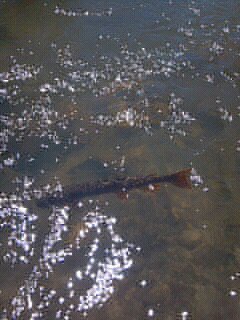
I made a decision then that I rarely make, which was to backtrack. I knew there was another long pool about twenty yards downstream beneath the narrow rapids because I had just caught a couple of fish there. It was difficult to negotiate the thick willows to get back there, but I believed there was a good chance the big cutt would linger in that pool and I might spot him again. And so it was. When I arrived at the downstream pool and poked my head over the protective brush, the cutt was quietly finning in a very shallow eddy, facing downstream near the tailout of the pool. Again, heart palpitations. The problem was, as any experienced fly fisherman can tell you, that getting a fly to drift naturally in an eddy across a strong current is an exceedingly difficult task. I’ve heard it said a thousand times that “a fish doesn’t get to be that big by being stupid.” A good drift was a prerequisite for fooling that trout, and I didn’t think I had a chance. Nevertheless, catching a trout of his stature in Pebble Creek was probably a once-in-a-lifetime affair even if I fished there regularly, so I slowly positioned myself upstream, behind the finning levithan, to give it a college try.  Here's the fish, trying hide beneath the twinkling glare:


In an overabundance of caution, my first couple of casts landed a foot or so behind the fish, producing no reaction. As I feared, the drift of the fly was unacceptable even if I had cast further - my leader was in the current, swept away too soon. I took a step forward and tried again. This time the Adams, still trailing the nymph, landed about six inches in front and to the right of the nose of the trout. I figured the fish would either spook and run or would ignore the flies. In the best case, I imagined, he might show an interest in the nymph before the current pulled it away. For an agonizingly long time - probably only a few seconds though it seemed an interminable period - the big cutt eased toward my flies an inch at a time. I had put as much slack into the leader as I could manage with my cast and a quick mend, but I knew the current would grab it at any moment. Miraculously, the flies just hung there, barely moving with the natural backflow of the eddy. The cutt’s nose inched forward until it touched the Adams. It was all I could do to let the fly sit while the cutt inspected it. I was sure I was in for rejection. Then boom! The trout sucked in the Adams!

I cannot describe my joy. As I set the hook and struggled to hold the big fish in the pool and land him (or more likely, her), I thought back on my boyhood experience. Maybe I stood in the same pool under the same bright skies in the shadow of the same mountains, I’m not sure. But in the present as is in the past, my excitement was beyond measure - pure ecstasy. Sometimes, though it happens all too rarely, everything goes just the way you plan it. Your stealth is stealthy, your fly is the right fly and holds its drift, the trout is fooled, and he’s yours. And when it all works out and you look around at the incredible natural scene that surrounds you and your prize, joy is almost overwhelming.

I hadn’t brought my regular cameras but I did have my smartphone, so I tried to take a picture of the trout as I held it in my hand. Problem was the cutt was too long to fit in the picture, even though I held out my arm as far as possible and positioned the phone behind my shoulder.   I have five photos of the rear 2/3 of the fish, not respectable enough to post here.  However, I was able to measure him against my rod for later verification of his length and I got some pictures of him in the water. At 19.5”, he was a veritable Moby Dick by the standards of Pebble Creek. Not a tarpon by any means, but a fish I will always be proud to have captured and released.

There is so much more I could tell you about the past few days. When I can, I will write another retrospective post to describe my day in Pocatello, Idaho, where the time warp fully enveloped me. I would also like to tell you about the quiet camping spots I occupied the past two nights - one in the Portneuf Range and the other in the Caribou Rnage - and the campfire meals I enjoyed there. Or the fish I caught on the Portneuf River (including the big one that got away off a gifted streamer) and on Toponce Creek (before a thunderstorm drove me from it) and on Tincup Creek. Or the time I spent with Roger Thompson of Portneuf River Outfitters - thanks for the info, Roger! Or the incident in the storm when I helped a drenched cowgirl open a stuck gate that trapped her and her soaked horse and dog. Or the hundreds of white terns wheeling around mysteriously in the mountain passes east of Gray’s Lake NWR. Or the intense cold that settled on Camelot, my righteous Northstar camper, last night. Or the fortitude and stamina of Excalibur, my Chevy Silverado, who recently has performed the kind of difficult, high-clearance-required, off-road stunts she was acquired to do, all without a misstep.

There is so much I could tell you. Since time has a way of folding back upon itself, I’ll hope for another chance in the future to relive and transcribe those for-now untold experiences. In the future I will tell of the past which is my present. That’s why I’m the once and future fly fisherman - I love it!