Monday, August 1, 2011

Days 66-72, July 25-31, Jackson Hole to Yellowstone to Dillon MT


That's not a self-portrait above.  It's a young bull moose lazing away a sunny afternoon north of Jackson Hole, Wyoming.  Just want to make sure you're not confused since you haven’t heard from me for a while. I spent five days last week in Jackson Hole and Grand Teton National Park with Trish, happily focused on her. The past few days I roamed around Yellowstone Park and southwest Montana.  Most of the time I've been without an internet connection. In fact, I still don’t have a connection as I write this, but I hope to find one tomorrow and post this blog.

In Jackson Trish and I stayed in a resort perched high on a ridge with mountain and valley vistas in every direction, including a view of the Grand Teton to the northwest. We dined at fancy (by Jackson standards) restaurants, in particular the Snake River Grill, which I highly recommend for dinner if you're in the area. One evening we attended a concert in Teton Village, which has a beautiful music hall right at the base of the ski runs.  Sarah Jarosz, a 20-year-old progressive bluegrass artist from Austin, performed an excellent show.

I joked with Trish that with her I was living high on the hog compared to how I’ve usually been living this summer - decidedly low-rent. Those days in Jackson could easily have spoiled me, but I’m back in Camelot now, again enjoying the simple life except that I miss Trish's presence. One of the elements of my life I’ve been pleased with is that it has covered a broad spectrum - geographically, vocationally and avocationally, upscale and downscale.  Reflecting on our 31 years of marriage while in Jackson, Trish and I agreed that we prefer to use our monetary resources to buy experiences rather than things. In one of my early blog posts I posited that life is a collection of experiences. If you buy that, you may agree that our approach makes sense. In any case, it was great to spend those days relaxing with Trish. I didn’t even fly fish.  I had planned to fish in the Snake River, but it remains high and off-color, which was fine under the circumstances.

When Trish left Jackson on Friday I aimed Excalibur at Yellowstone Park, and specifically to the Madison Campground, which is situated above the confluence of the Gibbon River and the Firehole River.  The joining of those two rivers gives birth to the Madison River, which is much-revered in fly-fishing circles. The scenery was outstanding and the fishing was pretty good. Here’s a panorama of the upper Madison River Valley taken from a spot on the south bank of the river just below the Gibbon/Firehole confluence (this would be a good time for you to double-click on the picture to blow it up and get the full effect):


As you can see, the river is broad, but fortunately it's only about thigh-deep in most places so I had an easy time wading it. I had heard that the Madison was crowded and the trout difficult to catch but neither of those rumors turned out to be entirely true. Caddis imitations - both dries and nymphs - were effective at catching a dozen or so rainbow and brown trout in a few hours of fishing on Friday afternoon and again, downstream a few miles, on Saturday morning. I had no problem finding room to fish. The other fishermen I saw didn’t appear to have much expertise and I didn’t see them catching anything.  The trout seemed to be concentrated in certain locations.  Finding them and being willing to move around were the keys.  My only disappointment was that the trout weren’t very large, as you can see from the two photos below of an average-size rainbow and a similar brown:


I hooked one fairly large fish on the Madison, but he came unbuttoned quickly after teaching me a small lesson. Conventional fly-fishing wisdom says that dries and nymphs must generally be fished with as natural of a drift as possible. But I hooked the big one while lifting a caddis nymph from the water in preparation for the next cast, inadvertently deploying a technique called the "Leisenring Lift."  Caddis were hatching in large numbers. When caddis hatch, they start from the rocks on the bottom of the river, create an air bubble that’s attached to their body, and swim/float to the surface as quickly as possible to avoid being eaten on the way. But the tactic doesn’t always work, and trout are happy to gulp the escaping caddis nymphs if they can. The lesson I learned (not for the first time) was that I shouldn’t get too fixated on the conventional methods of fishing. The biggest fish tend to be caught by fly fishers who do things a little differently.


Driving through the gorgeous Madison River Valley in Montana Saturday afternoon, I was tempted to stop and fish at any number of good-looking spots along the road to Ennis, but I decided I’d had my fill of the Madison, and drove on toward Dillon, passing through Virginia City and Twin Bridges. Virginia City has preserved its old western gold-mining town façade quite nicely. Driving through it, I was reminded of a time when I was a boy and my family visited there to watch my brother, Dave, race his mid-60s vintage Austin Healey Sprite, or perhaps it was his MGB - I can't remember which car he owned at the time. He and my sister-in-law, Glenda, used to race sports cars frequently back then. My brother was always competitive and he had box-loads of trophies to show for it. Later he raced catamarans and won more often than not, and even now, in his sixties, he’s still racing. This time it’s bicycles, which is probably better for his health. Driving through Twin Bridges, I passed the R.L. Winston headquarters. Winston is a prominent maker of fly rods, and their particular rods are reputed to have a certain unique “feel.” I can attest to that. I own a couple of Winstons that I really love. The sight of the HQ prompted me to pull out my Winston 9’ 5-weight IMX for my next adventure.

In Dillon I stopped by a fly shop to see if I could hire a guide and boat to float the Beaverhead River Sunday or Monday.  There weren’t any guides available so I decided to set up Camelot in a campground south of town on the river and try fishing from the bank. I was a little pooped and went to bed early that night. The next morning, refreshed and full of Italian breakfast sausage and French toast, I tackled the Beaverhead for an hour or so. The Beaverhead holds a lot of big fish, but the problem is that it’s predominantly narrow and deep, which makes wading difficult. Nevertheless, I stalked one of the banks near the end of the campground, which is also a park.  I managed to land a 14-inch brown trout on a tiny pheasant tail nymph, so it was worth the effort for a short time. A church group moved into a group picnic area near me after about an hour and started an outdoor service. When the singer-guitarist began to perform “My Sweet Lord” (a Hindu-inspired song!), I decided to sneak away, wondering what George Harrison would have thought about the situation.

Around 11 AM I drove Excalibur downriver in search of another spot to try my luck on the Beaverhead, but I happened to drive past the access to Poindexter Slough and decided to stop there instead.  Many years ago my friend Bill Nelson recommended that I try Poindexter Slough when I got a chance and I still remembered that. The name of this stream makes it sound like some kind of alligator-and-bullfrog-infested ditch in Louisiana, but in fact the Slough is a wonderful little spring creek that meanders north, more or less parallel with the Beaverhead, before the two join in Dillon. In the parking lot I chatted with a guy from California. He said he’d fished on the Slough a couple of prior occasions, but it didn’t sound like he’d done very well. Spring creek fishing can be tough, as I knew from experience on streams like Hot Creek in California. But I cracked the code on Hot Creek and caught dozens of fish on some days there, so I figured I could crack the code on the Slough.

Off I trundled through the brush with my Winston rod rigged with a 13-foot leader, 6X tippet and a tiny mayfly emerger pattern. For good measure, I also tied on a trailer fly - a size 22 olive WD-40 - about 18 inches off the hook of the emerger. It took me about a half hour to bypass a couple of other fishermen and locate a rising trout.  The first one I spotted was consistently coming up to gorge on a prolific hatch of pale morning duns (PMDs), and I began casting to him. Apparently my diligent preparation and delicate tippet and fly selections were the ticket to success.  In short order I hooked and landed the modest-sized brown trout that had tempted me with his repeated splashing. For the next few hours I worked my way slowly upstream. Other fly fishermen were remarkably sparse, which was a pleasant surprise, and overcast skies bolstered my confidence. The PMD hatch continued unabated for several hours.  In some stretches of the stream I spied several risers in close proximity. My WD-40 trailer drew most of the attention from the trout at first. Most of the risers were relatively small fish compared to the reputed average size of trout in the Slough. But as the afternoon wore on, the clouds thickened and the PMD hatch petered out, only to be replaced by a hatch of another, smaller species of mayfly.   At that point I began to see bigger noses nudge out of the water near the undercut banks. I clipped the trailer fly, lengthened my tippet and tied on the smallest olive parachute mayfly pattern in my fly box.

The bigger trout proved to be the challenge I was led to expect them to be. Each time I located one of the larger risers, I snuck up on him as best I could and cast my tiny dry fly across stream, striving to get as good of a drift as possible. But even when my casts were right under the bank and the drift was perfect, the trout would let the fly go by untouched 95% of the time. I noticed that a lot of real flies were drifting over the heads of the same fish and concluded that the problem wasn’t my presentation. I wasn’t getting refusals. There were so many actual flies in the water that the trout didn’t need to come up for every one. They had plenty enough to eat by rising only occasionally. So the only thing to do was to keep plugging at each of those fish. Some of those trout were so tightly tucked in under the bank that I could never get them to take my imitation, but in a few cases I was successful. The 14-incher below was not the biggest fish I hooked but he was the biggest one I landed.  A couple of larger fish demonstrated a remarkable facility for leaping and writhing like tarpon and throwing the hook in the process.  But the brownie in the picture may have been the strongest trout I ever caught relative to his size.  As soon as he took my fly he jumped three feet out of the water, then immediately rocketed 30 feet upstream along the far bank, spooking a couple of other big fish there. He gave my 6X tippet the full test for several minutes, but in the end I pulled him to my side of the Slough and was very glad I recently invested in a new net.  Here he is, along with a picture of a typical section of the Slough:


So all in all it was another great few days on some of the most famous and challenging waters in the west, on the heels of a marvelous week with Trish.  Lots of rainbows and browns landed on the Madison. One trout landed on the Firehole in only 10 minutes of fishing there. One trout landed on the Beaverhead. About a dozen trout landed on Poindexter Slough. Everywhere I look there are mountain ranges crested with snow, sparkling streams, broad valleys and steep canyons. As I write this, Camelot is parked near the Beaverhead.  Across the river are thousands of swallows darting in and out of little holes in a big cliff named the “rattlesnake cliff” by Captain Clark of Lewis and Clark fame.  Clark was almost bitten by a rattlesnake at this site, according to a nearby monument. His journals speak of his troop having dined on rattlesnakes that evening, and of him having caught many nice trout here a little over 200 years ago. Sweet.

Again, time turns on itself, like the snake Ouroboros that eats its own tail. What will tomorrow bring?  I can't wait to find out.

Monday, July 25, 2011

Days 62-65, July 21-24, Henrys Fork ID to Jackson WY

I'm a little past the halfway point on my journey now, just looking over the hump to the other side, reflecting on what has passed and what is to come.

In the immediate future (i.e., today), Trish will join me in Jackson, Wyoming and we'll spend several days enjoying the pleasures of one of the local resorts and touring the Tetons.  You may know Jackson as "Jackson Hole" - so-called because it was one of the locations of the annual fur trapper rendezvous back in the 1830's when the fur trade had its heyday in the mountain west.  It later became a rough-and-tumble cowboy town, and eventually a ski resort and retreat for the rich and famous.  Real estate prices, as in places like Aspen and Sun Valley, are ski-high, recession notwithstanding.  Still, it's a fun place, and the nearby Teton Range is easily one of the most awe-inspiring in America.  Here's a picture of the heart of the range, including the Grand Teton (Big Tit, in English), which I took a few days ago from the western side of the range in Idaho:


That picture now enjoys a place as the desktop background on my laptop computer.  And by the way, did you know that you can double-click on these pictures to blow them up to a larger size for better viewing?

On Day 62 I traveled from Tincup Creek through the Salt River Valley (which, like much of the general area, shows the effects of real estate spillover from Jackson - e.g., lots of vacation homes, mostly of log construction), then up through the agricultural lands between Driggs and Ashton, ID, and finally to a campground high on the Warm River.  My intent, as usual, was to avoid crowds.  The campground was lovely but I shared it with a calvary of ATV riders, including lots of teens and tweens.  I have no problem with ATVs but a troop of kids mounted on them all hours of the day and night isn't exactly subtle in terms of its detrimental impact on one's sense of quiet and solitude.  But I put that aside and, on Day 63, packed my lunch and gear into a small backpack, hooked on my bear spray and wading staff, and hiked a couple of miles downriver to get away from the hubbub.

My plan worked.  After some considerable boulder-hopping I ascended a steep ridge on the east side of the Warm River to gain perspective and find easier hiking conditions.  The ascent was difficult but worth it.  It was a little scary being alone up in the woods in bear country, but the creepiness soon dissipated when I peered over the ridge and saw a gorgeous meadow through which the Warm River sensuously snaked.  Fortunately the descent to the meadow was less daunting than the earlier ascent to the ridge, and I had any easy time navigating to the head of the meadow.  On the way I hopped over a series of springs that gushed from the side of the ridge, adding volume to the river.  Here's what the Warm River looked like from the ridge, looking downstream:


Once in the meadow I found perfect conditions for fly-fishing with my Scott Mountain Rod.  The water was clear, the bottom gravelly and firm, the streamside vegetation low and the pools and pockets deep.  The scene had trout written all over it, and before the day was done I caught about 50 brook trout.  Although native to the eastern US, not the west, brook trout have thrived in the cold mountain rivers where they were planted long ago, and are as beautiful there as anywhere else.  Here's an example of a typical brookie I landed on a well-worn Royal Wulff:


After working my way upstream through the entire meadow and well into the canyon, I finally caught so many fish that I started spending most of my time admiring the idyllic scene I was in and enjoying the solitude.  Idaho is ablaze with wildflowers this time of year and I was happy to take a close look at the many varieties, including these:


I believe the red and yellow ones in the second picture are a type of columbine - one I hadn't seen before.  The salmon-colored stem in the third picture is an Indian paintbrush, one of my favorite varieties of wildflower, usually more reddish in hue than the examples I saw here.  I also admired the lava rock formations, remnants of relatively recent volcanic activity that occurred throughout eastern Idaho.  It was all too beautiful.  I was dead-tired at the end of the day and slept right through the chaos in the campground.

The next morning I decided to tackle the nearby Henrys Fork.  You may recall from a couple of posts back that I fished a section of the Henrys Fork above Mesa Falls a week or so ago.  This time I steered Excalibur to the fabled Railroad Ranch section of the Fork that meanders through Harriman State Park (Harriman was a railroad baron way back when).  Here are a couple of views of the Ranch section of the river, the first showing a glimpse of the distant Tetons watching over a gaggle of geese and a bevy of swans in the slow current, and the second showing the surviving buildings of the Ranch, which still operates as a cattle ranch:


This section of the Henrys Fork and nearby sections of the river at Last Chance and Island Park are fabled among fly fishermen because of the spring creek nature of the river and the finicky trout that occupy it.  Apparently the fly-fishing travel agencies in France have been exceedingly effective at convincing their clients that the Henrys Fork is the place to go, because French seemed to be language of substantially all the fishermen I encountered there, including these two:


As I approached the riffle in the picture above the two Frenchmen decided to leave, which was nice of them.  I found that I had now had the Railroad Ranch section of the river all to myself, which seemed very odd considering that it is known as much for being crowded as for its challenging fishing.  There had been lots of fishermen there in the morning but apparently they had had enough humiliation, or perhaps they knew better than me that the afternoon was not the best time to linger there.  In any case, numerous trout began to rise shortly after they left, and I was able to catch six modest rainbows on small dry flies, including a tiny paradun and a slightly larger parachute Adams,  in a couple of hours.  According to the guide books, the proper approach to fishing the Fork is to locate a large rising trout and "stick with it."  That seemed to be sound advice.  The problem was, I could not locate any large trout.  With the water clarity being what it was (i.e., exceptionally crystal) and the breeze modest, one might have expected to have an easy time locating them, if they were there.  I can't help but wonder, frankly, if the hype about the Fork exceeds the reality.  Maybe the problem was my inadequacy as a fly fisherman in a truly challenging situation, but I suspect the problem was equally that the large fish are few and far between in that area of the Fork, or they were all in hiding at that time of day, perhaps tucked under the impressive weed beds in the deepest channels.  It is said that most fly fishermen walk away from the Henrys Fork humbled by its trout.  I didn't feel so much humbled as duped.  But I will always remember that it was as pretty of a scene as could be imagined and I did after all catch six trout, so I can at least say that I had some measure of success on what is reputed to be the river that requires the greatest measure of fly-fishing skill of all rivers.  I would have liked to have at least seen some evidence of a large trout, however.

That evening I hustled back southeast in Excalibur past the South Fork of the Snake River, stopping briefly to fish on a tributary called Falls Creek where I caught a couple of Snake River-finespotted cutthroat trout that were easily the equal of the rainbows I caught on the Henrys Fork.  Sunset was rapidly approaching.  After checking out a couple of campgrounds that were full, I finally settled into the last available site at the Alpine campground on the east end of Palisades Reservoir.  Fortunately the prior occupants had left firewood.  Relaxing by a campfire, I savored a glass of Oban on ice as the stars began to pop out.

The next morning - yesterday - I drove into Jackson and caught up on chores:  laundry, car wash (Excalibur and Camelot are gleaming today), air in the tires, fresh propane, etc.  In a few more hours Trish will arrive.  I can't tell you how much I look forward to her being here.  Fly fishing time may be minimal this week, but happiness will not be.

Thursday, July 21, 2011

Days 59-61, July 18-20, Pebble Creek ID

As Einstein reported long ago, space and time are married at the hip. Space is curved, time is relative to the position and motion of the clock-watcher, and Rod Serling still speaks to us through a wry grin from the Twilight Zone. And it’s all rendered more complex by the persistence of memory.

Over 45 years ago, according to our shared conventions of counting the time, I hacked through willows and gingerly plodded through marshes by a little stream on the eastern slopes of the Portneuf Mountains in southeast Idaho and came upon a beaver pond. In that quiet water several trout scattered in reaction to my sudden presence. The visible pool was abandoned but I knew the trout were still there, hiding in the margins. I quietly dipped the little lure on my spinning rod into a small, dark hole beneath overhanging branches and felt the tug of an 8-inch rainbow trout. My eyes were as big as Frisbees when I pulled that fish from the water. It was the first trout I ever caught - perhaps the first fish of any kind. The scene is embossed on my brain for as long I shall live.

Yesterday, caught in a time warp, I hacked through willows and plodded through marshes by a little stream - the same stream, Pebble Creek - flowing from the flanks of Haystack Mountain and Bonneville Mountain in the Portneuf Range. This time I was armed with a short, 3-weight Scott Mountain Rod and countless hours of experience hunting trout on small streams across the country. The trout had no chance, and in a short span of minutes I caught a couple of 8-inch cutthroats. Not rainbows. In the decades since I last visited Pebble Creek, stocking of non-native trout in the upper reaches of the stream has ceased, and the native cutts are the primary residents in this sanctuary. Fine with me.  Here's what a typical hole on little Pebble Creek looks like today, just as it did when I first trod its banks as a boy:


Soon I happened upon a long run of deeper water and cast a parachute Adams into a seam at the head of the pool. A tiny trout instantly hit the fly but I failed to hook him. I was about to move on when I noticed a long, sinewy shape slither out of the deep pocket in the main current and briefly occupy an eddy next to it. For several seconds I gaped at the long, green-backed fish with its reddish fins - telltale signs of a mature Yellowstone cutthroat. This was not a normal resident of Pebble Creek, I knew. It could only be a cutt that had migrated up the creek from the Portneuf River to spawn, and was slow to return home. As my heart began to race, the cutt dissolved back into the cover of the current.

Obviously my parachute Adams hadn’t impressed him, so I decided to attach to the hook bend of the Adams about 18 inches of fluorocarbon tippet, a small flashback pheasant tail nymph and a number 6 shot. That process took a few minutes. Just as I finished and was set to make a cast with my new and improved rig, the large cutt reappeared at the tail of the current and slowly dropped back, soon passing right beneath me, sneaking away as if he knew he was about to be targeted. As I cursed my luck, he slid into the rapids at the tail of the pool and disappeared into downstream narrows.

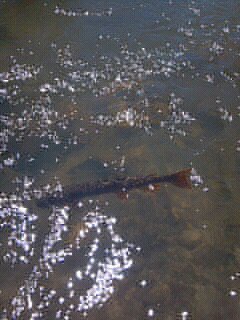
I made a decision then that I rarely make, which was to backtrack. I knew there was another long pool about twenty yards downstream beneath the narrow rapids because I had just caught a couple of fish there. It was difficult to negotiate the thick willows to get back there, but I believed there was a good chance the big cutt would linger in that pool and I might spot him again. And so it was. When I arrived at the downstream pool and poked my head over the protective brush, the cutt was quietly finning in a very shallow eddy, facing downstream near the tailout of the pool. Again, heart palpitations. The problem was, as any experienced fly fisherman can tell you, that getting a fly to drift naturally in an eddy across a strong current is an exceedingly difficult task. I’ve heard it said a thousand times that “a fish doesn’t get to be that big by being stupid.” A good drift was a prerequisite for fooling that trout, and I didn’t think I had a chance. Nevertheless, catching a trout of his stature in Pebble Creek was probably a once-in-a-lifetime affair even if I fished there regularly, so I slowly positioned myself upstream, behind the finning levithan, to give it a college try.  Here's the fish, trying hide beneath the twinkling glare:


In an overabundance of caution, my first couple of casts landed a foot or so behind the fish, producing no reaction. As I feared, the drift of the fly was unacceptable even if I had cast further - my leader was in the current, swept away too soon. I took a step forward and tried again. This time the Adams, still trailing the nymph, landed about six inches in front and to the right of the nose of the trout. I figured the fish would either spook and run or would ignore the flies. In the best case, I imagined, he might show an interest in the nymph before the current pulled it away. For an agonizingly long time - probably only a few seconds though it seemed an interminable period - the big cutt eased toward my flies an inch at a time. I had put as much slack into the leader as I could manage with my cast and a quick mend, but I knew the current would grab it at any moment. Miraculously, the flies just hung there, barely moving with the natural backflow of the eddy. The cutt’s nose inched forward until it touched the Adams. It was all I could do to let the fly sit while the cutt inspected it. I was sure I was in for rejection. Then boom! The trout sucked in the Adams!

I cannot describe my joy. As I set the hook and struggled to hold the big fish in the pool and land him (or more likely, her), I thought back on my boyhood experience. Maybe I stood in the same pool under the same bright skies in the shadow of the same mountains, I’m not sure. But in the present as is in the past, my excitement was beyond measure - pure ecstasy. Sometimes, though it happens all too rarely, everything goes just the way you plan it. Your stealth is stealthy, your fly is the right fly and holds its drift, the trout is fooled, and he’s yours. And when it all works out and you look around at the incredible natural scene that surrounds you and your prize, joy is almost overwhelming.

I hadn’t brought my regular cameras but I did have my smartphone, so I tried to take a picture of the trout as I held it in my hand. Problem was the cutt was too long to fit in the picture, even though I held out my arm as far as possible and positioned the phone behind my shoulder.   I have five photos of the rear 2/3 of the fish, not respectable enough to post here.  However, I was able to measure him against my rod for later verification of his length and I got some pictures of him in the water. At 19.5”, he was a veritable Moby Dick by the standards of Pebble Creek. Not a tarpon by any means, but a fish I will always be proud to have captured and released.

There is so much more I could tell you about the past few days. When I can, I will write another retrospective post to describe my day in Pocatello, Idaho, where the time warp fully enveloped me. I would also like to tell you about the quiet camping spots I occupied the past two nights - one in the Portneuf Range and the other in the Caribou Rnage - and the campfire meals I enjoyed there. Or the fish I caught on the Portneuf River (including the big one that got away off a gifted streamer) and on Toponce Creek (before a thunderstorm drove me from it) and on Tincup Creek. Or the time I spent with Roger Thompson of Portneuf River Outfitters - thanks for the info, Roger! Or the incident in the storm when I helped a drenched cowgirl open a stuck gate that trapped her and her soaked horse and dog. Or the hundreds of white terns wheeling around mysteriously in the mountain passes east of Gray’s Lake NWR. Or the intense cold that settled on Camelot, my righteous Northstar camper, last night. Or the fortitude and stamina of Excalibur, my Chevy Silverado, who recently has performed the kind of difficult, high-clearance-required, off-road stunts she was acquired to do, all without a misstep.

There is so much I could tell you. Since time has a way of folding back upon itself, I’ll hope for another chance in the future to relive and transcribe those for-now untold experiences. In the future I will tell of the past which is my present. That’s why I’m the once and future fly fisherman - I love it!

Monday, July 18, 2011

Days 56-58, July 15-17, Meeteetse WY to Mesa Falls ID

If a fisherman yells "big fish!" on a river and there's no one there to hear him, does he make a sound?  Does it make a difference if he yells with a French accent - i.e. "beeg feesh!"?  I'll leave that to the philosophers and scientists to sort out, but I'll let you in on the story behind these profound questions shortly.

First I must pay homage to my close friend Don (Chip) Walter, who is featured in the short video at the following link:    http://www.youtube.com/watch?v=6Ux06_oYnt4


The video was shot the day before I left Wyoming and two days before Chip had an accident while working on a construction project at his cabin, breaking a leg and a wrist.  He's now laid up in casts and is not nearly as happy as he was when the video was shot.  It could have been worse - he was operating a chain saw when he fell from his deck.  At least he still has both his arms and legs.  I don't mean to make light of it.  I hope he retains fond memories of the day the video was taken.

As I've reported on several occasions recently, finding good water in the rivers and streams of the northern Rockies is not an easy task these days - heavy snow runoff continues in most places.  However, if you search hard enough, you can find it, as Chip and I did on Friday.  Laughing off reports of a mama grizzly and cubs in the area but packing plenty of bear spray, we hiked up the South Fork of the Wood River, an obscure tributary of the Wood River that flows into the Greybull River, which flows into the Bighorn River, which flows into the Yellowstone River, which flows into the Missouri River, etc..  There we found Yellowstone cutthroats, not as sizeable as those we typically catch in the Wood or Greybull, but large and numerous enough to satiate us for a couple of days or, in Chip's case, perhaps for a couple of months.  Best regards, Chip.  I wish you a speedy recovery.

Chip's calamity had not yet occurred when I powered Excalibur through Yellowstone Park on Saturday.   There I paused to watch Old Faithful erupt while enjoying a frozen yogurt cone.  The massive spew was impressive but didn't move me nearly so much as did my first glimpse of the Teton Range rising in the southwest as I descended the pass from Pahaska Teepee down to Yellowstone Lake.  The Tetons brought back many memories of childhood, such as the time I squeezed myself into the slot behind the two seats in my brother's Austin Healy Sprite and rode in it with my parents to Teton National Park where my brother had a summer job.  That memory turned into a fountain of recollections by the time I got to Pocatello, Idaho late Sunday.  More on that in the next post.

Driving on from Old Faithful, I flashed by the Firehole, Madison and Gibbon Rivers and was strongly tempted to stop.  The water was in superb condition and I saw a couple of fly fishermen landing fish.  I sorely wanted to try my hand, but fate had something else in store for me, and I soon passed into West Yellowstone, Montana and then into Idaho, generally following the course of the Henrys Fork of the Snake River.  The Henrys Fork is one of the west's most famed and popular fly fishing rivers.  Large stretches of it are backed up by several reservoirs that effectively convert the Henrys Fork into a series of tailwater fisheries with varying characteristics.  One characteristic shared by most of the tailwaters is that they are very crowded with fishermen, as evidenced by the numerous fly shops, outfitters, RV parks, and fishing lodges along their banks, as well as the hundreds of trucks and SUVs parked in every little burg, many of them trailing drift boats and rafts.  It's discouraging if you're trying to find a quiet place to camp and fish, as I was.

But you know how I am.  If there's a quiet fishing place to be found, I have a good chance of finding it.  Armed with a Forest Service map, Excalibur and I ventured into the backwoods, bouncing through muddy potholes and ruts on several dirt roads just north of Upper Mesa Falls until we eventually dropped into a canyon and descended to the river.  Pulling up to a boat ramp at the end of the road, I found a single vehicle containing a sole passenger, so I stopped to inquire whether I could camp there.  Soon I was engaged in a productive and pleasant conversation with T.C., a fly-fishing guide from Teton Valley Lodge who was kind enough to give me the low-down on that stretch of the river and even a few stonefly imitations that he plucked from his well-worn cowboy hat.  T.C. had a couple of clients, nice gents from Kansas City, who were wrapping up an "epic day" by wade-fishing near the ramp after having floated several miles in T.C.'s drift boat.  I took a few pictures of them standing in the river and off they went with fond goodbyes.  In a matter of minutes I popped Camelot's top up, strung up my Sage Z-Axis 5-weight, and was in the river casting one of the yellow stoneflies T.C. had given me.  Here's a glimpse of the river I was graced to sample:


It was all too beautiful except for one thing - apparently the fish were done eating stoneflies for the day.  In an hour or so of evening fishing I only enticed one fish to rise, so I decided to make dinner and get a fresh start in the morning.  I was a bit frustrated when three fisherman entered the river by the ramp, having hiked down the road from somewhere.  But as I dined inside Camelot to avoid the gathering gnats and mosquitos, I enjoyed a panoramic view of the river and decided to watch the interlopers for a while.  At first I thought they looked like a trio of rubes because their hats, vests and waders seemed odd.  (Yes, fashion has infected even fly fishing.)   But I could see that they were good casters, and I could hear their voices clearly carrying across the water.  They were speaking French!  That explained their odd dress, I suppose.  My American fly fishing outfits probably look ridiculous in France.

As the sun dropped behind the western ridge of the canyon and the twilight lingered, I patiently watched the Three Musketeers - for so I had dubbed them - as they consistently failed to catch any fish.  Then suddenly, when one of them threw an unknown fly into the mid-river riffle right in front of me, I heard a shout:  "Beeg feesh!  Beeg feesh!"  That got my full attention.  Peering down on the scene, I saw that there was indeed a commotion on the end of the guy's line, but his rod didn't have much of a bend in it and so the fish didn't seem very big to me.  I guess it's a matter of which standards you apply.  Perhaps it was a big fish by French standards.  I'm not aware of France being an important trout-fishing destination, although I do recall that Hemingway had some luck there almost a hundred years ago.  In any case, the trout unhitched itself from the guy's fly before either of us got a good look at it.  Then on the next cast the same thing happened, but this time the fly rod bent a little deeper and I was almost starting to be impressed.  At least he was hooking up, which was better than I had done.   What little success he had was not enjoyed by his les amis.  As deepening darkness finally drove them from the river, I watched them jaunt merrily up the road and heard them laughing.  At one point - I swear - they joined one another arm in arm.  All for one and one for all!

I woke up Sunday morning just as the sun lit up the high rock wall that lined the west bank of the river.  It was exactly the kind of sight I hoped to see often when I planned my trip.  There was not another human in evidence, and in fact there was not to be one all day long.  I casually ate breakfast, loaded a fanny pack with the proper fly fishing accoutrements, pulled on my waders and boots, applied sunscreen and bug repellent, attached my bear spray (again, amid reports of mother grizzlies and cubs in the area) and a wading staff, and launched myself into the wide, shallow river.  I'll give it to the Henrys Fork - there may be no more beautiful river in existence.  Even though it's large, you can wade it in most places, and the river bottom is a wonderous thing replete with patches of gravel, healthy vegetation and lava rocks - a seemingly perfect environment for trout and the flies they feed on.  The bugs were very evident, as they had been the previous evening.  All the usual suspects were there:  mayflies and caddis of various sizes and a few big, buzzing stoneflies - the very bug I was trying to imitate with the lead fly on the end of my tippet.

The Henrys Fork also has a reputation for being a tough place to catch fish even though the trout are plentiful.  Since I was in a lightly-fished area occupied predominantly by rainbow trout that are smaller than the average Henrys Fork trout, I thought I would have no problem.  As it happened, I only caught eight rainbows in about six hours of fishing, and all of those were on nymphs.  In the last half hour, having returned to the riffle below Camelot where I had seen one of the Musketeers hook a few fish the prior evening, I tied on a trusty parachute Adams (about which I wrote in one of my earliest blog posts), and my catch rate went up dramatically.  The trout weren't particuarly hefty, but each time I hooked one I could not stop myself from shouting into the empty canyon, "Beeg feesh!  Beeg feesh!"  Did I make a sound?  I think so, because there was a dazzling bald eagle flying overhead, and surely he wondered why his fishing grounds were suddenly plagued with foreigners.

Anyway, it's a good thing I didn't fall in and knock myself out, because I was only a short distance from Upper and Lower Mesa Falls.  If I had been carried away in the current, my ultimate fate would have been sealed here:


I could go on and on with this post and if you've read this far you're wondering if it will ever end.  I badly want to tell you about my day in Pocatello but I'll save that for next time.  I just want to share two last photos with you now.  I mentioned the Tetons earlier.  Here is the heart of the range in a photo taken across an expanse of emerald farm fields not far from Driggs, Idaho:


It's hard to argue that the Tetons aren't the most beautiful mountains in America.  And speaking of beauty, my last photo has nothing to do with it.  Some of you may be wondering how much of a wild man I've turned into after two solid months of camping and fishing.  Let me assure, not at all, as you can see for yourself:


The picture doesn't do full justice because you can barely see the "wings" of hair sticking out over my ears, which also look really great popping out from under a hat.  Anyway, it's not how you look, it's how you feel.  Right?  I feel great.

Friday, July 15, 2011

Days 52-55, July 11-14, Northern Wyoming

If you read my last post you may have gotten the impression I wouldn't be fly fishing this week.  That was what I intially thought, but life is full of pleasant surprises if you're open to them.  In this case, because I was unable to fish in the usual places due to continuing high runoff, my long-time buddy Chip and I were prompted to consider alternatives we normally might have rejected.  As always, there was a lesson to be learned, or relearned:  when I'm forced to change, more often than not the new experiences I have are more interesting than the old, repetitive experiences, if for no other reason than that they are new.

Specifically what happened is that on day 53, after a day of rest and relaxation at Chip's cabin, we took Chip's canoe to Luce Lake - a spring-fed beauty that lies at the base of the Beartooth Mountains north of Cody, WY.  Chip had been there once, many years ago, but I had never seen it.  As we carted the canoe down to the lake shore after a quarter-mile hike from the parking area, we immediately understood the potential for a good day on the lake; just a few feet off shore there were several large rainbow trout cruising in shallow water.  So we launched with great expectations under a crystal sky and aimed for an area where we saw fish rising under a set of overhanging trees.

I came armed with both a fly rod and a spinning rod.  The fly rod was a 5-weight Sage XP loaded with a sink-tip line on an Abel reel.  I started with the spinning rod, however.  On the first cast a trout hit my lure hard, but I was unable to hook him.  That led us to believe we would be catching fish left and right.  It turned out it wouldn't be quite so easy, in part because the breeze picked up and a little rain squall moved in.  Still, we each caught several large rainbows and a couple of smaller ones, including one on a suspended red midge fly on the fly rod.  Here are a couple of examples of the fine, fat Kamloops rainbow trout we brought to the canoe and released:


That's Chip in the first picture, and me in the second.  My only regret was that I didn't leave the sink-tip line in the car and bring a floating line instead.  A couple of fly fishermen casting dry flies from the west shore were having a fine time catching trout that were cruising the shallows there.  Still, no complaints.  We caught beautiful fish in gorgeous surroundings and shared one end of the lake only with ospreys and this yellow-headed blackbird:


The next day we got off to a slow start but eventually drove Camelot high into the Bighorn Mountains to the edge of the Cloud Peak Wilderness.  On the way we passed numerous rivers and streams flowing very high and fast, but we were encouraged because the water in the streams flowing directly from the mountains was much more clear than what we saw elsewhere across the Bighorn Basin.  We settled into our campground that evening, took a short hike around West Ten Sleep Lake, and cooked a tasty steak dinner over a campfire before being driven inside Camelot by a rain shower.

Day 54 dawned brightly.  Chip and I carried the canoe to the lake and launched it into gin-clear water, paddling toward the north end of the lake where West Ten Sleep Creek flows into it.  Again I carried two kinds of rods, but soon found that the fly rod was the most productive.  Even though we saw very few rising fish, we discovered that a dry fly cast into areas around underwater shelves and current breaks had an excellent chance of being consumed by a hungry brook trout.  It was great fun, but our primary objective for the day was to hike up Middle Ten Sleep Creek to Mirror Lake, which we proceeded to do in the afternoon.

Early in the hike we fished briefly in a long meadow where the creek was clear and slow even though the water level was high.  I tied on a size 10 (i.e., large) Royal Wulff dry fly and, in short order, caught several orange-bellied brook trout.  Some were larger and even more colorful than the ones I managed to photograph, but here's an example or an average brookie from the meadow:


Soon we were ascending a non-trail along the precipitously-dropping creek, aiming for the lake a couple of miles up the slopes of Cloud Peak.  As it turned out we had missed the main trail, and as a consequence had to endure a certain amount of confusion along with some bushwhacking and rock-climbing.  Our reward was that we found another couple of high meadows where the creeks were teeming with visible brook trout and the scenery was outstanding.  Here's a little peek at what we encountered:


You may notice I'm wearing a rain jacket in the picture above.  Just before the photo was taken we ran into a light shower, which later became a thunderous downpour, causing us to seek shelter under a thick stand of trees.  But we were soon climbing and fishing again.  The trout weren't complete pushovers but we caught a lot of them, including this fabulous young cutthroat that Chip captured with a small spinner:


We never did make it to Mirror Lake, having taken a wrong turn when we were within a half mile.  Fortunately we ran across the main trail on the way back, and had a much easier time of it hiking down the mountain.   We made it back to Camelot as the sun settled on the western ridges.  I made us each a large bowl of fusilli with a spicy tomato sauce and we enjoyed our final evening sitting by a tall campfire.  A couple of deer paused to graze about 20 feet away as a full moon ascended, peaking through a stand of tall lodgepole pines.  It was a fine end to a day of adventure and discovery.  Deja vu for Chip and me; we've made many a hike like this one and stretched our tired legs before many a warm fire by a mountain lake.  It was on a trip much like this one, some twenty years or so ago, that I first decided to learn how to fly fish after seeing Chip catch several huge cutthroats on a bubble and fly with his spinning rod on a lake high in the White Cloud Mountains of central Idaho.

I'll turn a new page tomorrow, aiming Excalibur toward southeast Idaho.  Before I leave Meeteetse we'll probe the foothills of the Absaroka Range in one last attempt to find a clear-flowing stream in our usual stomping grounds nearby.  I'll let you know in the next post how that goes.  I'll leave you with this shot of Excalibur and Camelot, with Chip's canoe perched on top:

Sunday, July 10, 2011

Days 42-51, July 1-10, Nevada to Wyoming

This post covers many days and a lot of road miles.  It's been a transition period, one that was supposed to evolve from a quiet break with Trish in Las Vegas to a new set of fly-fishing adventures.  The quiet break happened as planned, punctuated by an evening and a night at the Palazzo resort on the Strip and dinner at Postrio.  Trish and I had a wonderful time together.  On the morning of the 6th we said goodbye again.  Driving north from Las Vegas, I thought a lot about the dynamics of marriage.

Trish often informs me during our daily phone calls that many people she talks to are bewildered by my decision to be away from her for the better part of four months, or by her decision to "let me" be away for so long, or both.  Apparently these earnest folks believe that I'm too irresponsible or that she's too generous, or both.  With all due respect to those reading this who may be among the people feeling and expressing such sentiments, that perspective is rather narrow, I think.  My journey is not about being away from Trish.  Being away from her is an unfortunate side effect of my pursuit of personal passions, necessary in part because Trish has little or no interest in fly-fishing or camping in remote places and I don't want her to have to feign interest or endure activity that bores her.  I gladly reciprocate, enabling her to pursue substantially all of her own personal interests, including frequent visits to far-flung friends and family.  We respect each other's individuality.  That, to us, is an essential component of love.  Of course I miss Trish when we're apart, as I've reported many times.  If I thought I would never be with Trish again after this trip, my immediate priorities would change and I would return home now, because in the long run there is no higher priority than being with her.  But neither of us is so pessimistic, fearful or insecure that we must constantly cling to one another as if an absence were anything more than temporary.  In my opinion, unless a couple happens to share exactly the same interests all the time (hard to imagine), the best thing they can do for one another - the beating heart of true love - is to support one another's passions and obsessions.  There would be few adventurers - no astronauts or sailors or soldiers or explorers or foreign correspondents, for example - if there weren't husbands and wives somewhat comfortable with the notion of being separated for relatively long periods.  In the big picture, four months isn't a long time, and we'll be together for the better part of a week on three separate occasions during the remaining 70 days of my trip.  I look forward to each of those occasions with great relish.

Maybe I'm feeling defensive now because of the consistently gloomy skies I've been under since I arrived in Las Vegas.  I've gazed upon many spectacular scenes the past five days - giant hoodoos and chimney rocks, magnificent ridges and cliffs, red rock canyons and snow-capped peaks.  Most of the time, those scenes were in the shadows of clouds, and sometimes were veiled behind black sheets of heavy rain.  Worse than that, all the rivers I crossed, and there were many, were high, muddy and virtually unfishable due to an abnormally cold and snowy spring across most of the mountain west.  I planned to be fully re-engaged in fly fishing by now, following the Vegas break, but the full transition may yet take some time due to the late runoff.

That said, I snuck in two short fly-fishing sessions on the way north from Vegas.  They were fiascoes for the most part, but not entirely without reward.  The day I left Vegas I drove Excalibur into the southeast highlands of the Wasatch range in central Utah.  I had always wanted to fish the Fremont River, but it quickly became apparent that the sections of the river most frequented by fly fishers were high and muddy.   Also they are on private land accessible only to certain guides.  So I moseyed up a narrow road high into the mountains nearer the headwaters of the Fremont.  The water there was off-color but low enough for me to recognize potential.  I situated Camelot in a quiet spot between the road and the stream where there were no other human souls within sight or earshot, strung up my 3-weight mountain rod, and made the short hike through sagebrush to the little river.  My disappointment about the water quality was exacerbated when I discovered that the river banks were severely degraded by cattle.  Still, I ducked under the tight brush to a small pool that showed promise and was surprised to discover one of the most prodigious hatches of mayflies, caddis flies and even little yellow sallies (a small stonefly) that I've ever witnessed.  A trout revealed itself to me in the fast current coarsing through the gray pool, rising to a large mayfly.  I immediately cast an elk hair caddis into the current and fooled a 10-inch brown trout.  Within a few minutes I caught two more like him on the same fly, then repositioned myself to cast into a little eddy behind a protusion in the bank.  I required several tries before my fly landed in the exact spot it needed to be, an inch away from the bank at the top of the eddy.  I was shocked when a fat 16-inch brownie sucked in the fly and swam several circuits around the pool before I could bring him to hand.  Unfortunately I hadn't brought my camera, so you'll just have to take my word for it that he was a prize, coming from such a small river. I tried to find another pool upstream but didn't get far before I stepped into what appeared to be a solid piece of grass but turned out of be one of a multitude of deep holes dug by cow's hooves.  For a few seconds I was seriously worried as my right leg sunk into mud high up my thigh.  I was barely able to reach a nearby limb that gave me just enough leverage to unplug myself from the mud.  Fiasco or epiphany?  You be the judge.

The next morning I drove backroads up through Utah, much of which looked spectacular between breaks in the clouds.  My goal was to camp along the Green River south of Flaming Gorge Reservoir.  The land surrounding the reservoir was green and gorgeous and the dam was impressive in height, so I thought I'd made a good call.  But just as I pulled into a gas station in the town of Dutch John above the river canyon, dark skies unleashed a torrent of rain, then hail, and frequent bolts of lightning that sounded like they were striking just across the parking lot.  I took it as a sign, even if it was just coincidence, that I should roll on.  I crossed the border into Wyoming a short time later.  I eased Excalibur down the steep grades from the Uinta Mountains into the high desert, taking a short detour west shortly before Rock Springs.  The detour took me down into the Firehole Canyon to a little-visited arm of the Flaming Gorge Reservoir where I found an empty campground and set up Camelot before an amazing vista.  Late in the evening, the sun made a brief appearance from behind the clouds just before dropping over the horizon.  I took this photo of the scene while cooking dinner over a campfire:


I retired when night fell, just as a couple of families were moving into the campground.  They managed to erect their tents and crawl into them just before the next storm charged in.  For the next few hours I was occasionally torn from slumber by distant thunder and the steady patter of rain on Camelot.  It was soothing, actually.

The next morning after coffee and pancakes I navigated to the town of Green River before turning north again to follow the river to the Seedskadee National Wildlife Refuge.  There I stopped to read the historical markers describing the nearby pioneer trails and the ferries that carried wagons across the river, which was normally swollen in the early summer when most of the pioneers arrived.  On the occasion of my visit, swollen was a word that couldn't contain the reality of the torrent.  The Green River would be more accurately named if it were the Grande Cappucino River.  Ever the optimist, I strung up my Sage XP 5-weight rod.  Easing down the steep river bank to a shallow ledge of loose rock, I positioned myself near an eddy where there appeared to be enough slow water for fish to congregate.  I made dozens of casts with many different kinds of nymphs and dries, drifting the nymphs as deep as I could, but to no avail.  I know there are large trout in the river, but apparently they weren't where I thought they should be on that day.  Still, the sun was shining at that moment and the hatching insects were even more prolific than on the Fremont two days prior, so it was a pleasant stop, all in all.  I counted at least four different kinds of mayflies, including the large and narcissistic specimen perched on Excaliber in the picture below, in addition to caddis flies of every size and the largest midge species I have ever seen - beautiful little creatures with flourescent green heads and pinkish bodies draped with long, shimmering, transparent wings.  Despite all that food washing around the eddies along the banks, the mighty river was not forthcoming with trout.


I took my time on the banks of the Green, taking pictures of the blooming prickly pear cacti and the aquatic flies that seemed fascinated by Camelot and were trying to get in it.  I also made a peanut butter and jelly sandwich - an exquisite treat on a fine afternoon among the cottonwoods.

Heading northeast, I gradually crept up on the Wind River Range, which is one of the most impressive mountain ranges in the west.  For a time the clouds formed a halo over the range, shading the lower slopes but allowing the sun to illuminate the snow-shrouded tops, to dizzying effect.  A little farther northeast, a long curtain of rain occupied the desert slopes between the highway and the mountains.  I steered Excalibur as gently as possible along its leading edge, buffeted in the transition zone between 80-degree and 55-degree slabs of air, tunneling through the noisy deluge, dodging lightning.  I finally eased out of the storm near South Pass, notable as one the main routes through the Rockies for tired pilgrims and their wagons in the 19th century.  The Sweetwater River, the Sandy River, the Popo Agie River, the Wind River, the Big Horn River - all high and muddy and unfishable.   Past the Red Canyon near Lander, WY I drove (see picture below). Then through the narrow gorge where the Wind River slices through the Owl River Mountains.  Through Thermopolis and its bubbling and sulphorous hot springs.  Through the Big Horn Basin east of the southern Absaroka Range.  And finally to Meeteetse where I spent the evening with my close friends of many years, Chip and Julie.


Julie has now departed to see friends and family in Iowa, but I'm still in Meeteetse with Chip.  Yesterday we hauled a flatbed trailer with Chip's friend Billy to Billings, MT to pick up some lumber and hardware, crossing the turgid Greybull, Shoshone, Clark's Fork and Yellowstone Rivers on the way.  The bridge across the Yellowstone is very near the site of last week's oil spill where an Exxon pipe that was supposedly buried safely beneath the river bed burst and dumped a gusher into the river.   The drilling won't stop - you can be assured of that.  Last night we visited the Cowboy Bar, reputed to have been frequented by Butch Cassidy and other notorious characters during the joint's formative years.  A local band, 9 O'Clock, played some solid rock-and-roll for a rowdy crowd.  We loved it.  Fly-fishing time will come again, when it can.  My near-term plans are fluid.

Monday, July 4, 2011

Retrospective

Today is the anniversary of our nation's independence.  Trish and I are celebrating it in Las Vegas where we're being hosted by Trish's beloved sister Kathy, her husband Byron, and her daughter Megan.  Having a few days with no fishing activity has given me an opportunity to catch up on some personal business, and also this opportunity to transcribe certain recent thoughts and experiences that I've not had time to write about up to this point on my odyssey.

When I was in New Mexico I mentioned that I would cover the subject of religion in a future post.  This is it - now's the time.  Don't worry, I don't plan to say anything that's terribly controversial or offensive to anyone's personal religious convictions or lack thereof.  I promise to show all due respect.  As I've driven through 18 states on my journey so far, I've often seen things that remind me of my own religious experiences, and that's what I want to cover in this post.  As I am sometimes wont to do, I will even connect this topic to fly fishing if you are patient enough to read the entire post.

It may come as a shock to those of you who haven't known me as long or as closely as some others have, but I grew up in a Southern Baptist family and, during my undergraduate college years, was a part-time evangelist and missionary.  I briefly attended a seminary and strongly considered becoming a pastor.  For a variety of reasons I didn't follow through.  Suffice it to say that by changing my course I did a big favor for myself, all Baptists and just about anyone else I may have touched in my life.  I'm quite certain now that God wasn't calling me to be a minister.  But I learned some valuable lessons and had some very interesting experiences in the period of my (occasional) piety, and am often reminded of them now.

When I was in New Mexico a couple of weeks ago, one of the campgrounds I stayed in was a stone's throw from Glorieta, which is the name given variously to:  1) a town, 2) the high mountain pass where I-40 crosses the Sangre de Cristo range to Santa Fe, 3) a monument to a Civil War battle near the pass, and 4) a camp and conference center founded by Southern Baptists in the 1950s which is still operating today.  As I drove by Glorieta, and again when I drove into Las Vegas a few days ago, I was reminded of the summer of 1972 when I was a "missionary" in Las Vegas.  I concluded that season by attending the annual Southern Baptist youth conference in Glorieta.  It would take a book to properly contain the story of that summer:  prowling the back rooms of the Vegas entertainment centers with the "Chaplain of the Strip," being interviewed on air by the then-top local radio personality Walt Reno, preaching fire-and-brimstone sermons that, to my own surprise, generated remarkable power to bring certain vulnerable people to their knees.  I was a dumb, immature kid with no common sense.  What did I know?  I didn't know anything, but there I was grappling with Satan in Sin City with a message of fear, hope and redemption.  Wow.

In mid-August of 1972, a Las Vegas pastor drove me all the way to Glorieta where I joined some of my friends from Iowa and maybe another thousand or two thousand kids in their late teens and twenties at the youth camp.  In those days I was also a musician with intermediate proficiency playing the guitar.  Each day at the camp, lunch was served in a big auditorium and there was an open microphone for those with sufficient courage and talent to attempt to entertain the lunchers.  One of my buddies and I were contemplating performing as a duo.  I possessed a cheap twelve-string guitar and had composed a song that my buddy and I worked into a passable arrangement.  On the day we planned to step up on the stage, the opening act was a good-looking, long-haired guy who performed the Led Zeppelin song "Tangerine," accompanying himself on 12-string guitar.  That kid blew us away.  Substantially all the other performers sang traditional or modern Christian-themed songs, but this kid wowed us with a decidedly secular tune.  If we had closed our eyes, we could easily imagine that Jimmy Page and Robert Plant were on stage, but it was just this one charismatic kid.  When he was finished, my buddy and I were totally deflated.  There was no way we were going on stage to follow that act.  That's what I remember most about Glorieta - an awesome rendition of "Tangerine."

But my preaching, praying and singing days weren't over then.  A couple of years later I traveled with a group of my Baptist friends from Iowa to attend a large Christian conference in Dallas and another smaller conference in Norman, home of University of Oklahoma.  At some point during that trip we were invited to a church service in Del City, Oklahoma, which is a small city that I recently drove by on my way from Memphis to New Mexico.  If I recall correctly, during the early and mid-70's, the Del City church was reputed to be the largest Southern Baptist church in the world.  (Not long after that, the esteemed pastor of the church was elected President of the Southern Baptist Convention, and not long after that, the church defaulted on $14 million of bonds that it issued to build the mighty edifice that I visited and otherwise extend its ministry.)  I'm not sure whether the Del City church was in fact the largest of its kind, but I do know that the church's auditorium and its congregation were duly impressive in size, and it was intimidating.  At that church I found myself standing before thousands of folks, leading them in prayer and playing my guitar.  Wow.  Have I said before that I was just a dumb, immature kid with no common sense?  In the couple of years between the summer in Las Vegas and the service in Del City, I hadn't learned much at all, but once again I was held out as an authority to a large group of people who were apparently eager to obtain my spiritual guidance.  Did I give them any useful guidance, spiritual or otherwise?  It's hard to imagine that I did.  A world in which a dumb, immature kid with no common sense is respected as a mouthpiece for God is a strange world indeed, but that's our world.

What do my experiences reveal?  People are spiritually hungry.  Even people who don't know they are spiritually hungry are spiritually hungry.  There are all kinds of ways in which they try to satisfy their hunger.  Some go to church and adopt certain sets of dogma, and some take advice from people with messages that sound right even if the people with the messages actually have no idea of what life or spirituality is about.  I'm not ashamed to say I have a spiritual hunger.  This is where fly fishing comes in.

Regardless of your actual beliefs, assume for a moment that the Bible contains the Truth.  If you put together the collective statements of the prophets and apostles purported to have written most of the books of the Bible, you must conclude that God is omnipresent.  Specifically, the spirit of God is in all places, according to the Bible.  I personally believe that such a statement is representational rather than literal - that is, it's a specific Christian/Judaic expression of a universal truth that there a cosmic mind permeating everything that we humans, with our limited senses and imaginations, can wrap our minds around.  When I go fly fishing, I tap into that cosmic mind, or God, if you will.  Out in those vibrant places where streams tumble and tree leaves tremble, where surf crashes and grains of sand constantly shift positions in the endless dance of the elements of creation, I find myself looking over the precipice into the great abyss where my senses cannot penetrate and up into the cosmos where untold billions of stars, seen and unseen, speak to the inhuman scale of the multiverse.

Shortly before I left Pennsylvania in mid-May, my friend Eric Schaffhausen reminded me of the historical association between fish and Christians.  That association is why you often see fish symbols gracing the car bumpers of modern fundamentalists.  The fish symbols on their vehicles are marks of their Christian affiliation (and are often a giveaway of hypocrisy when the drivers of those cars practice road rage).  If you read the Bible it becomes obvious how this association was formed - e.g., some of the apostles were fishermen, Jesus asked them to be "fishers of men," Jesus multiplied the fishes for a hungry crowd, etc.  I have my own interpretation of how fish symbolize the search for spirituality.  The surface film of a river or other body of water is the border, or curtain, between the seen and the unseen.  Beneath the surface film is a watery, alien world in which the inhabitants - fish and certain insects and other aquatic creatures - move and breathe in ways that we humans cannot.  We cannot live in that world.  When I cast a fly into or beneath the film on the water and a fish eats the fly and I pull the fish through the veil that separates us and I touch it, it seems almost magical, as if I were reaching up into the sky and an angel's hand suddenly materializes and touches mine.  Fish, like the fairies of the pagan religions or angels of the Biblical tradition, come from another place -  a place that's foreign and strange, but a place that we want to connect to, precisely to solve some of mystery associated with it.  Unless they are protecting us from something specific that we fear, we don't like fences, walls, curtains and other objects that separate us from something else.  We are curious about what's on the other side.  Sometimes the borders are not physical objects; they are simply the limitations of our senses.  Spirituality is about connecting with realities that are beyond the limits of our senses - things that we cannot see, smell, taste, hear or touch.  Connecting with a fish through fly fishing is within the limits of our senses.  It is not spirituality per se, but is symbolic of spirituality.  Consciously or unconsciously, the practice of fishing reminds us of our spiritual strivings and, in some small way, satisfies them.

My journey around America is like floating on a great oceanic current.  I look around and I see other boats and I remember being on some of those boats.  I see great steeples like the spaceship spires of the Mormon temple in La Jolla, CA, tall crosses like the rough-hewn "old rugged cross" attached to a rural Virginia church, and signs proclaiming the path to salvation like the dozens of billboards with Bible verses scattered on the roadsides across the Bible Belt.  I've been on that boat.  I'm on another boat now but I'm still casting lines in the water, connecting with mysteries and wondering what else may be swimming up my chum line or rising to a blue-winged olive.